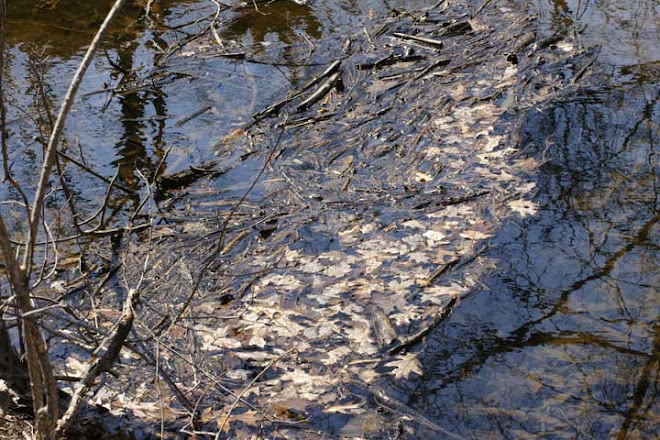
This is the second of two current river songs. It was inspired by a very short commercial spot designed for the Huron River Watershed Council that I saw once that showed cars going by on a road with the question "Where is the River?". The camera then panned down to the ditch by the side of the road and answered the question: "Closer than you think..."
If anyone is interested in writing some of their own water or river songs, and participating in spontaneous public performance this winter, please contact me! I could also imagine some kind of water-themed flash event on public transportation, so if you have ideas, do let me know!
Where is the River
Showing posts with label water. Show all posts
Showing posts with label water. Show all posts
Saturday, January 15, 2011


Friday, January 14, 2011
River Songs-Everything Flows
"Every single thing we do as animals we do because we are an aqueous solution."
Lynn Margolis
I spend a lot of time on and along the river near my house; I go to visit it every day. I've been doing so for over twenty years. I came to realize that I was made of the river, and that its waters were flowing through my veins, that my cells were swimming in it, that it flowed through me just as surely as it flows through my neighborhood and my town.
I sometimes say that I only want to write music that I would sing to myself for my own edification if I were in a field alone, and this little song definitely fits into that category.
I wanted to write some simple songs that would express this intimacy with the waters, and the immanence of the river. I have the simple hope that if we come to love the river, we will not hurt it, since we are dependent on it, utterly. If you love God, you gotta get right with God, and if you love the Dharma, you are compelled to live rightly by the Dharma, and if you learn to love the river, you've got to get right with the river.
We are quite dependent upon the river for our moment to moment existence. In this way, our relationship to the waters makes me think of the Zen Master Samu Sunim's teaching about "true suchness": that which is "intimate, immediate, spontaneous and obvious."
This is meant to be one of a small set of "guerilla art" songs I've created to sing on buses during the winter here in Ann Arbor--our University is organizing a semester's worth of events around the theme of Water, and this is one of my contributions.
So here is my first attempt at a simple river song:
Everything Flows:
Lynn Margolis
I spend a lot of time on and along the river near my house; I go to visit it every day. I've been doing so for over twenty years. I came to realize that I was made of the river, and that its waters were flowing through my veins, that my cells were swimming in it, that it flowed through me just as surely as it flows through my neighborhood and my town.
I sometimes say that I only want to write music that I would sing to myself for my own edification if I were in a field alone, and this little song definitely fits into that category.
I wanted to write some simple songs that would express this intimacy with the waters, and the immanence of the river. I have the simple hope that if we come to love the river, we will not hurt it, since we are dependent on it, utterly. If you love God, you gotta get right with God, and if you love the Dharma, you are compelled to live rightly by the Dharma, and if you learn to love the river, you've got to get right with the river.
We are quite dependent upon the river for our moment to moment existence. In this way, our relationship to the waters makes me think of the Zen Master Samu Sunim's teaching about "true suchness": that which is "intimate, immediate, spontaneous and obvious."
This is meant to be one of a small set of "guerilla art" songs I've created to sing on buses during the winter here in Ann Arbor--our University is organizing a semester's worth of events around the theme of Water, and this is one of my contributions.
So here is my first attempt at a simple river song:
Everything Flows:
Monday, October 25, 2010
Useless Places II
Last summer I was looking at an old children’s picture book from the 1960’s called “Nature” that kept talking about “useful” insects and “useful” animals—presumably all of the “useless” ones were the “harmful pests” that kept popping up in the text. This is an attitude that would bend the whole earth to our human uses, and classify all beings by their relationship to our technologies. And it runs so deep that we teach our children to parrot it before they can even fully read.
As we give in to our habitual ideological separation of ourselves from the world, we are prone to justify our destructions as being themselves akin to natural processes—the children’s book I mentioned above flogged the old imaginary equivalence of a Hoover Dam to a beaver, explicitly suggesting the rectitude of the ways and means by which we alter our environment by analogy with purposeful animal behavior. Leaving aside for a moment even the question of the scale of such alterations in considering the relative merits of that justification, it seems to me that there is a major difference in the set of assumptions that drive such behavior.
I’m no beaver psychologist, but we can make a solid guess that the animals around us do not suffer from the same chronic sense of separation from their environments that we do, and this artificial mind-trick we engage in allows harm to flow from us. We may talk of mother earth, but we somehow fail to give her credit for what we fancy we have been able to achieve with all our usefulness—we’re like a toddler when we point to our tottering constructions with pride, as if we had done it all ourselves, when of course our loving parent stood behind us so we wouldn’t fall, bought us the blocks, fed us the food that would give us the energy to make our tower, kept the tigers away while we did it, and repeatedly and surreptitiously righted our mistakes so that we could have a feeling of accomplishment.
Perhaps we should reflect on our own true position: are we “useful” beings, or are we “harmful pests?” Can we aspire instead to achieving the unstated designation in the center, and redeem ourselves by becoming “useless?”
As we give in to our habitual ideological separation of ourselves from the world, we are prone to justify our destructions as being themselves akin to natural processes—the children’s book I mentioned above flogged the old imaginary equivalence of a Hoover Dam to a beaver, explicitly suggesting the rectitude of the ways and means by which we alter our environment by analogy with purposeful animal behavior. Leaving aside for a moment even the question of the scale of such alterations in considering the relative merits of that justification, it seems to me that there is a major difference in the set of assumptions that drive such behavior.
I’m no beaver psychologist, but we can make a solid guess that the animals around us do not suffer from the same chronic sense of separation from their environments that we do, and this artificial mind-trick we engage in allows harm to flow from us. We may talk of mother earth, but we somehow fail to give her credit for what we fancy we have been able to achieve with all our usefulness—we’re like a toddler when we point to our tottering constructions with pride, as if we had done it all ourselves, when of course our loving parent stood behind us so we wouldn’t fall, bought us the blocks, fed us the food that would give us the energy to make our tower, kept the tigers away while we did it, and repeatedly and surreptitiously righted our mistakes so that we could have a feeling of accomplishment.
Perhaps we should reflect on our own true position: are we “useful” beings, or are we “harmful pests?” Can we aspire instead to achieving the unstated designation in the center, and redeem ourselves by becoming “useless?”
Tuesday, October 19, 2010
Useless places
I’ve thought for some time that the most beautiful places are often the “useless” ones. Where I live, the productive properties are almost all ugly: quarries, industrial parks, commercial strips, giant mono-cultural factory farms, office-cubicle hives…all ugly and based on destruction, seemingly free from the vibrant organic flowering forth of life.
I want to sing a song of the beautiful useless places, the places that have no economic benefit. Because they are worthless and unwanted, they were either abandoned, or left alone. The swampy headwaters that no one bothered to drain, the too-steep slopes of the bluffs down to the river, the shifting dunes by the lake, or the poor land that could not support farming and was left to heal, slowly, ever so slowly. Wherever we thoughtless modern humans gave up on “getting” anything from the land and it could just tend to itself: those are the places we are drawn to in our hidden animal minds.
It wasn’t always that way. I visited my friend Keith Taylor on a huge tract of research land owned by the University of Michigan, which was itself “worthless” in the late 1800’s after its forest had been clear-cut, and fires had killed off most all of the vegetation and wildlife. Since it was worthless, the timber barons gave it to the state for cheap. Since it was useless, it was allowed to sit undisturbed until it became beautiful again. Keith told me about a site he found near there with the archeological remnants of an old Ojibway summer encampment on a lake, a productive place for fishing and hunting and gathering food. When he looked around the site, he thought about why they’d chosen that particular spot, and came to the conclusion that it was because it was the most beautiful one that they could find. They wanted to be in beauty even in the “production” of food. Every fall when they left, they buried their gear, and the place was no less beautiful for their habitation of it.
I wonder if we will ever learn to do that—to find the uses of a place and work with it so it can still be beautiful. Until we do, I give thanks for all the useless places and their worthless beauty.
I want to sing a song of the beautiful useless places, the places that have no economic benefit. Because they are worthless and unwanted, they were either abandoned, or left alone. The swampy headwaters that no one bothered to drain, the too-steep slopes of the bluffs down to the river, the shifting dunes by the lake, or the poor land that could not support farming and was left to heal, slowly, ever so slowly. Wherever we thoughtless modern humans gave up on “getting” anything from the land and it could just tend to itself: those are the places we are drawn to in our hidden animal minds.
It wasn’t always that way. I visited my friend Keith Taylor on a huge tract of research land owned by the University of Michigan, which was itself “worthless” in the late 1800’s after its forest had been clear-cut, and fires had killed off most all of the vegetation and wildlife. Since it was worthless, the timber barons gave it to the state for cheap. Since it was useless, it was allowed to sit undisturbed until it became beautiful again. Keith told me about a site he found near there with the archeological remnants of an old Ojibway summer encampment on a lake, a productive place for fishing and hunting and gathering food. When he looked around the site, he thought about why they’d chosen that particular spot, and came to the conclusion that it was because it was the most beautiful one that they could find. They wanted to be in beauty even in the “production” of food. Every fall when they left, they buried their gear, and the place was no less beautiful for their habitation of it.
I wonder if we will ever learn to do that—to find the uses of a place and work with it so it can still be beautiful. Until we do, I give thanks for all the useless places and their worthless beauty.
Tuesday, September 28, 2010
Preach It Reverend Billy!
Reverend Billy is an activist/performance artist and visionary on a mission. He has recently been focusing on mountain top removal mining practices... visit his Church of Life After Shopping
from the Rev.'s facebook page:
Sept. 28
"Since I don’t have a television at home, when I’m in a motel I can’t help but surf around the channels. So I experience all those cop shows – with the manufactured evil that drives those stories toward the next commercial break. The evil is mostly meaningless, method actors with unshaven scowls...
This Appalachia Rising weekend in DC, oh - we got the underground explosive of actual Evil. Hair-raising wailing speeches by Larry Gibson, Maria Gunnoe, Dr. James Hansen, Debby Wilder – we felt the rocks flying over the trees, the selenium and arsenic and mercury rising from the interiors of the violated mountains… we felt the epidemics of children in the valleys. And then in the face of frightfully real evil the mountain people turn from their brave shouting and they start hugging. Lots of hugs, long slow hugs, and a steady rain of laughter - as if to steady themselves. They even hug people just arrived from the city.
This was the identification of the murderer Big Coal by citizens who do not accuse easily. These tragedies were not purchased by these people. This evil is not a media product. But we pay for these tragedies when we flip the wrong switch, turn the wrong dial – or leave the television on. We indulge our cheap evil, a different flavor evil and different cute-faced hero on each channel. Our little black-plastic gadgets are powered by living things the size of mountains exploded and scraped onto the vulnerable people nearby. It turns out that the disposable evil of everyday television has the oldest mountains inside, 280 million year old living beings are in the background of these cheapened stories. The mountains seem to be waiting for us addled viewers to recognize evil again for what it is, and then find our necessary goodness."
from the Rev.'s facebook page:
Sept. 28
"Since I don’t have a television at home, when I’m in a motel I can’t help but surf around the channels. So I experience all those cop shows – with the manufactured evil that drives those stories toward the next commercial break. The evil is mostly meaningless, method actors with unshaven scowls...
This Appalachia Rising weekend in DC, oh - we got the underground explosive of actual Evil. Hair-raising wailing speeches by Larry Gibson, Maria Gunnoe, Dr. James Hansen, Debby Wilder – we felt the rocks flying over the trees, the selenium and arsenic and mercury rising from the interiors of the violated mountains… we felt the epidemics of children in the valleys. And then in the face of frightfully real evil the mountain people turn from their brave shouting and they start hugging. Lots of hugs, long slow hugs, and a steady rain of laughter - as if to steady themselves. They even hug people just arrived from the city.
This was the identification of the murderer Big Coal by citizens who do not accuse easily. These tragedies were not purchased by these people. This evil is not a media product. But we pay for these tragedies when we flip the wrong switch, turn the wrong dial – or leave the television on. We indulge our cheap evil, a different flavor evil and different cute-faced hero on each channel. Our little black-plastic gadgets are powered by living things the size of mountains exploded and scraped onto the vulnerable people nearby. It turns out that the disposable evil of everyday television has the oldest mountains inside, 280 million year old living beings are in the background of these cheapened stories. The mountains seem to be waiting for us addled viewers to recognize evil again for what it is, and then find our necessary goodness."
Tuesday, September 21, 2010
Three Things
Earlier this year I appeared on Michigan Radio’s “Three Things” series, in which people offer three ideas to help our state in this time of crisis. Here is a rough approximation of what I said: my “Three Things We Can Do to Help Michigan” (or any other place, for that matter…)
You can hear the broadcast here
1. Michigan is defined by its waters, so one thing we can do is find out where our drinking water comes from and go visit it. Every single one of us lives in a watershed, so go find the headwaters of your nearest river, go Kayaking or canoeing, go for a walk along a nearby stream—if you do you’re sure to fall in love with it, and if we love the water we won’t want to pollute it.
When we come to understand that our lives are utterly dependent on the waters, we can begin to see that the rivers and streams are everywhere—not just between the banks and shorelines, but in the gutters and sewers under the street, in our sinks, and literally flowing through our veins. We can each immediately improve the heath of our waters by limiting our use of home toxics and not using fertilizers—if you live in an apartment complex or condominium talk to the management about cancelling the pesticide and fertilizer applications.
2. Keep art local: I’m a musician, so I often think about local art the way many people are starting to think about local food—it should be as fresh and locally grown as possible. We want our art it to taste like our own soil. One of the really great things about our state is the incredible number of local arts organizations that we have—for example there are so many regional orchestras in Michigan—this is something quite unusual about our state that we have to find a way to maintain. We can participate as performers, audience members, donors--Think about going to a live concert or play instead of renting a video, or join your local civic band. We all have the opportunity not only support local art, but also to make it ourselves. If we are all working together to build community organizations at the same time we are striving to make beauty out of everything around us, that cannot fail to improve our lives.
3. In these tough times you’ll hear politicians talking a lot about making Michigan competitive again, but I believe one of the most important things we can do is to think ourselves to a new metaphor that we can use to understand our relationship to each other. Maybe we could replace the idea of competition with collaboration. When we compete, someone always loses, someone is always suffering, even if we win. The truth is, we competed ourselves into this recession; we might have to do something else to get out. Competition is the game that led us to this catastrophe, so setting our determination to play the same game only harder is a nonsensical response. Competition tempts us to engage in a kind of ruthless self-interest that denies our responsibilities to each other.
If we can focus on stewardship of the natural beauties that surround us, and look to the arts as a model for how to cooperate to make meaning in our own communities and out of the stuff of our own lives, we might look around and see friends and neighbors instead of winners and losers. We might come to see the project of participating in the life of our state as a creative and cooperative one.
You can hear the broadcast here
1. Michigan is defined by its waters, so one thing we can do is find out where our drinking water comes from and go visit it. Every single one of us lives in a watershed, so go find the headwaters of your nearest river, go Kayaking or canoeing, go for a walk along a nearby stream—if you do you’re sure to fall in love with it, and if we love the water we won’t want to pollute it.
When we come to understand that our lives are utterly dependent on the waters, we can begin to see that the rivers and streams are everywhere—not just between the banks and shorelines, but in the gutters and sewers under the street, in our sinks, and literally flowing through our veins. We can each immediately improve the heath of our waters by limiting our use of home toxics and not using fertilizers—if you live in an apartment complex or condominium talk to the management about cancelling the pesticide and fertilizer applications.
2. Keep art local: I’m a musician, so I often think about local art the way many people are starting to think about local food—it should be as fresh and locally grown as possible. We want our art it to taste like our own soil. One of the really great things about our state is the incredible number of local arts organizations that we have—for example there are so many regional orchestras in Michigan—this is something quite unusual about our state that we have to find a way to maintain. We can participate as performers, audience members, donors--Think about going to a live concert or play instead of renting a video, or join your local civic band. We all have the opportunity not only support local art, but also to make it ourselves. If we are all working together to build community organizations at the same time we are striving to make beauty out of everything around us, that cannot fail to improve our lives.
3. In these tough times you’ll hear politicians talking a lot about making Michigan competitive again, but I believe one of the most important things we can do is to think ourselves to a new metaphor that we can use to understand our relationship to each other. Maybe we could replace the idea of competition with collaboration. When we compete, someone always loses, someone is always suffering, even if we win. The truth is, we competed ourselves into this recession; we might have to do something else to get out. Competition is the game that led us to this catastrophe, so setting our determination to play the same game only harder is a nonsensical response. Competition tempts us to engage in a kind of ruthless self-interest that denies our responsibilities to each other.
If we can focus on stewardship of the natural beauties that surround us, and look to the arts as a model for how to cooperate to make meaning in our own communities and out of the stuff of our own lives, we might look around and see friends and neighbors instead of winners and losers. We might come to see the project of participating in the life of our state as a creative and cooperative one.
Saturday, January 23, 2010
Bad News and Killer Carp
Bad news loves bad news. This week, the earthquake deaths in Hati mount, and confronting the breadth of human suffering brings us face to face with a misery we know we deserve as much as anyone else. Democrats lose their supermajority in the senate to a nude centerfold with a fancy pickup truck, and are ready to throw in the towel and stop trying to do what is right. The supreme court guts campaign finance reform, making the world safe for corporations to fully express themselves by purchasing our government.
But 100 pound fish are invading Lake Michigan? And we're not allowed to close off the canal that is their entryway? This is a joke, right?
The supreme court has refused to issue an preliminary injunction to close the canal that is allowing the asian carp into the great lakes from Chicago's waterways. The Obama adminstration is also against closing the canal, as it would presumably be "bad for business." Bad for the shipping business in Chicago, that is. But if it stays open it will be bad for the living business in Michigan and Wisconsin, but I guess they are throw-away states at this point.
The carp eat up to 1/5 of their body weight in plankton each day, and kill off all other fish species by eating all the food. The carp grow to up to 110 pounds, and are attracted to swimmers and small boats, often leaping onto them, causing serious injury. So if they invade the great lakes, there will be no commercial fishery there, no sport fishery, and tourism will go to hell. The state of Illinois has responded to Michigan's court cases by dumping unprecedented amounts of poison into the canal in the hope of killing all the fish species in the waterway. Of course those dead fish are eaten by birds, and passed up the food chain, and the poisoned water itself is flowing into Lake Michigan, but no matter...
But 100 pound fish are invading Lake Michigan? And we're not allowed to close off the canal that is their entryway? This is a joke, right?
The supreme court has refused to issue an preliminary injunction to close the canal that is allowing the asian carp into the great lakes from Chicago's waterways. The Obama adminstration is also against closing the canal, as it would presumably be "bad for business." Bad for the shipping business in Chicago, that is. But if it stays open it will be bad for the living business in Michigan and Wisconsin, but I guess they are throw-away states at this point.
The carp eat up to 1/5 of their body weight in plankton each day, and kill off all other fish species by eating all the food. The carp grow to up to 110 pounds, and are attracted to swimmers and small boats, often leaping onto them, causing serious injury. So if they invade the great lakes, there will be no commercial fishery there, no sport fishery, and tourism will go to hell. The state of Illinois has responded to Michigan's court cases by dumping unprecedented amounts of poison into the canal in the hope of killing all the fish species in the waterway. Of course those dead fish are eaten by birds, and passed up the food chain, and the poisoned water itself is flowing into Lake Michigan, but no matter...
Tuesday, January 19, 2010
Free the Huron River
If there were any kind of newspaper left in this city, the following would be an opinion piece or a long letter to the editor...
A very vocal group of citizens in my town (many of them my near and much-respected neighbors) has become very vocal in their support of leaving the aging Argo dam in place. This dam is at the end of my street, so it hits pretty close to home for me, as I kayak the waters behind the dam a few times every week when the pond isn't frozen. The state of Michigan says the city has to remove or repair it, and and the local watershed council has strongly recommended removal. My neighbors have framed their position on this issue with yard signs that say "Save Argo Pond."
By doing so they directly reference many other similar campaigns we have become familiar with: "save the whales", "save the Hudson", "save orchestra hall"...in each of these cases, though, there is a natural feature or a historic building or a community asset that is perceived to be threatened by destructive forces that are in the wrong, and there is a call for us to step up into individual responsibility to protect something that should not be destroyed. In this case however, there is a reversal I find ironic--the "save the" argument is being used in the service of the preservation of an aging dam that is proven to be bad for the health of the river, and at great expense to the city.
The city council is not meant only to make decisions based on the desires of narrowly defined economic elite, nor even on the basis of their perception of what the majority of their constituents want. Still less are they [you] meant to develop that perception based on who seems to be shouting the loudest, though it seems that that is often the most politically expedient thing to do. You [they] are also meant to serve as stewards for the all the lands of the city, the whole environment that those lands entail, the same environment that supports our human lives, and countless others.
If a group of people got signs printed saying "more toxic waste dumping," even if they seemed to be in the majority, even if they included the past president of the Downtown Development Authority or the chamber of commerce, it would be incumbent upon you [us] to say "no, that is not in the best interest of the whole community, and not in the best interest of the environment that supports our community."
In this way, the Huron river itself is like one of your constituents, or rather, like one of your charges--something that needs to be cared for and preserved as an essential part of our lives (it literally flows through the veins of everyone in this town)--but it can't speak for itself. Though I'm all in favor of recreation and cardiovascular health, I don't think the rowing team's reluctance to relocate, or the desire to keep Barton pond clear of rowing shells for the rich folks is enough reason to insist on going to great city expense to keep the river sick.
The Huron river is sick. It is sick because of what we have done to it. We cannot expect to keep making the environment upon which we depend for our existence sick, and somehow expect to be well ourselves. I urge you [everyone] to act as stewards, and to do what you know is right, even if it is hard: we must free the Huron river.
A very vocal group of citizens in my town (many of them my near and much-respected neighbors) has become very vocal in their support of leaving the aging Argo dam in place. This dam is at the end of my street, so it hits pretty close to home for me, as I kayak the waters behind the dam a few times every week when the pond isn't frozen. The state of Michigan says the city has to remove or repair it, and and the local watershed council has strongly recommended removal. My neighbors have framed their position on this issue with yard signs that say "Save Argo Pond."
By doing so they directly reference many other similar campaigns we have become familiar with: "save the whales", "save the Hudson", "save orchestra hall"...in each of these cases, though, there is a natural feature or a historic building or a community asset that is perceived to be threatened by destructive forces that are in the wrong, and there is a call for us to step up into individual responsibility to protect something that should not be destroyed. In this case however, there is a reversal I find ironic--the "save the" argument is being used in the service of the preservation of an aging dam that is proven to be bad for the health of the river, and at great expense to the city.
The city council is not meant only to make decisions based on the desires of narrowly defined economic elite, nor even on the basis of their perception of what the majority of their constituents want. Still less are they [you] meant to develop that perception based on who seems to be shouting the loudest, though it seems that that is often the most politically expedient thing to do. You [they] are also meant to serve as stewards for the all the lands of the city, the whole environment that those lands entail, the same environment that supports our human lives, and countless others.
If a group of people got signs printed saying "more toxic waste dumping," even if they seemed to be in the majority, even if they included the past president of the Downtown Development Authority or the chamber of commerce, it would be incumbent upon you [us] to say "no, that is not in the best interest of the whole community, and not in the best interest of the environment that supports our community."
In this way, the Huron river itself is like one of your constituents, or rather, like one of your charges--something that needs to be cared for and preserved as an essential part of our lives (it literally flows through the veins of everyone in this town)--but it can't speak for itself. Though I'm all in favor of recreation and cardiovascular health, I don't think the rowing team's reluctance to relocate, or the desire to keep Barton pond clear of rowing shells for the rich folks is enough reason to insist on going to great city expense to keep the river sick.
The Huron river is sick. It is sick because of what we have done to it. We cannot expect to keep making the environment upon which we depend for our existence sick, and somehow expect to be well ourselves. I urge you [everyone] to act as stewards, and to do what you know is right, even if it is hard: we must free the Huron river.
Friday, January 15, 2010
This Land is [Not] Your Land
I woke up this morning to the news that a new nickel mine in the Upper Peninsula of Michigan has been approved, thus guaranteeing that another part of our state will become a slagheap, and that poisonous mine tailings will be leeching into the waters of the great lakes for many years to come. Moments later, I heard again that the power company, with the aid of the state legislature, is fighting hard for a new coal plant, thus guaranteeing that Michigan will continue to do its part to support blowing the tops off mountains and filling the streams with mud in Kentucky and West Virginia, helping to turn our planet into the overheated toxic bathtub it was apparently meant to be.
It made me remember some alternate verses I wrote to "This Land Is Your Land" when I was a kid:
As I have travelled across the nation,
it seems to me it's one big corporation--
it's all a resource for exploitation:
This land was made for industry.
You've got the soil rights, but I've got the oil rights,
where wolves ran barking, now it's for parking,
straight from the gas pump to the toxic waste dump:
This land was made for industry
At the time, these words were meant to be an exercise in bitter sarcasm, written as I watched them uproot the old woods next to the Mennonite church for a shopping mall. The euphemism of the time was that that stretch of road was being "improved," and I remember hoping in my ten-year-old mind that satire might have some kind of power to show what was really being done. Certainly if we opened our eyes to the ridiculousness of the whole enterprise, I thought, we could look at what we were doing and be ashamed.
I was wrong. We have no shame. Three decades later, the scale of the second phase of suburban sprawl in my town seems quite quaint, more like child's play. By now, the Mennonite church itself has been bulldozed for a drive-through beer store, and we've tipped so far into bizarro-world that even wild exaggerations meant to make a point about the excesses of the 1970's seem to be a statement of the obvious, more like an actual manifesto for unrestrained commercial development than an ironic inversion of our real values meant to prick our conscience. We've gotten used to feeling that the corporate juggernaut can't be stopped, even when all indications seem to be that the cost of that rampage is the very life of our planet. It's become the status quo.
Outrage doesn't seem to work, and satire has been rendered moot. Shall we go on living in complicty with this system, and take it as a given?
It made me remember some alternate verses I wrote to "This Land Is Your Land" when I was a kid:
As I have travelled across the nation,
it seems to me it's one big corporation--
it's all a resource for exploitation:
This land was made for industry.
You've got the soil rights, but I've got the oil rights,
where wolves ran barking, now it's for parking,
straight from the gas pump to the toxic waste dump:
This land was made for industry
At the time, these words were meant to be an exercise in bitter sarcasm, written as I watched them uproot the old woods next to the Mennonite church for a shopping mall. The euphemism of the time was that that stretch of road was being "improved," and I remember hoping in my ten-year-old mind that satire might have some kind of power to show what was really being done. Certainly if we opened our eyes to the ridiculousness of the whole enterprise, I thought, we could look at what we were doing and be ashamed.
I was wrong. We have no shame. Three decades later, the scale of the second phase of suburban sprawl in my town seems quite quaint, more like child's play. By now, the Mennonite church itself has been bulldozed for a drive-through beer store, and we've tipped so far into bizarro-world that even wild exaggerations meant to make a point about the excesses of the 1970's seem to be a statement of the obvious, more like an actual manifesto for unrestrained commercial development than an ironic inversion of our real values meant to prick our conscience. We've gotten used to feeling that the corporate juggernaut can't be stopped, even when all indications seem to be that the cost of that rampage is the very life of our planet. It's become the status quo.
Outrage doesn't seem to work, and satire has been rendered moot. Shall we go on living in complicty with this system, and take it as a given?
Thursday, October 30, 2008
A Map of Lost Waters
As children, we mapped our world with creeks. We knew where they flowed—to the frog pond, into ditches beside the old railroad bed, north toward the Stillwater River. One ran all the way to the Mall. We followed them as far as we dared, walking alongside, wading in. Sometimes the banks were so slippery with viscous mud and clay that we could barely walk. We scooped up crawdads and tramped down stair-steps of sedimentary rock full of fossils. We knew where the vines were strong enough to swing out over the streambed. We knew which creeks ran all summer, and which ones were dry by late July, turned into reedy gullies at the edge of the cornfields. We knew where they ran fast (good for racing sticks) and we knew where they pooled around the fine red roots of the willow trees. We memorized their great stones, and their bars of gravel. We named the places near the water that held magic for us (Witches Lair, Glenwood, The Toy Fort, Warlock’s Will), but we did not name the creeks.
A mysterious series of fires around our area led to rumors that those who wouldn’t sell their land would be driven out. Then, there were bulldozers, massive earth-movers and backhoes leveling everything: they just plowed it all under. They knocked down farmhouses with the furniture still inside and trees that had stood for a century. We were still boys, and we got very excited by the thunderous power of those machines, which seemed like Mike Mulligan’s steam shovel on steroids. More often, though, we saw the workmen as our enemies, and we sat on the margins of the carnage mourning and bemoaning. They left no tree standing upright, and no sign of our subtle network of streams, just hard orange clay.
Once, a heavy rain hit, and the whole wasteland flooded. A temporary lake formed, four feet deep at the center. We dubbed it “Pond Superior,” in a burst of childish irony. We waded through it too, but it was featureless except for the name we gave it and the deep tread marks of the heavy equipment that we could feel with our feet. It was lifeless, full of muddy, brown, opaque water. Later, they gouged out a deep, straight ditch nearby, lined it with cement, and drained off the stagnant pool. For a time we scrambled over the eroding sides above the apron, building dams out of the clay for fun, trying to block the mini-gorges that formed. From this I learned definitively that nothing will stop water from finding its way down-hill.
Even in that stripped expanse, we children always sought the water, and knew instinctively that it was important to understand where it went, how it was all connected. When they laid the sewers and covered them over, we followed the streams underground, walking in the dark maze of pipes for what seemed like miles. We were following again the path of the flow, just a polluted trickle, among the raccoons and rats and cobwebs. This is a sad thing.
Our childhood stream-world was a paradise, a living web that included both our streams and our imaginations. I watched them bulldoze it, bury it, and encase it in concrete. I remember feeling that I had lost a friend. To this day, it is rather like a phantom limb, this thing that was part of me, that was severed.
There is an often remarked-upon naming practice whereby we call our housing developments and shopping malls after what was destroyed in order to build them. This is how unrelieved expanses of blacktop dotted with anonymous, air-conditioned boxes come to be called “Walnut Creek,” or “Greenbriar” or “Willowbrook Estates.” We name our “developments” after what used to be there, after what we have lost. It’s a last nod to the felt power of an actual place, and an attempt to convert that faint flash of recognition, that vestigial magic, into marketing. It’s an attempt to activate our sense of what we have been cut off from, to make us feel our phantom limb, and then to associate the ghostly tingling of remembered completeness with the knife that cut us.
“Development,” is a kind of name too, one that perpetrates a similar lie. “Development,” as it is currently practiced, is not the organic result of natural processes as the word (and its cousin term “growth”) insidiously suggests. “Development” is not inevitable and it is not usually necessary, no matter what insinuation the name might be asking you to accept. There is always another way.
We can have streams flowing through our towns, and in our backyards, with farms behind them. It is possible for us to live in places that are not all unnatural concentrations of near-identical houses, surrounded by close-cropped green-green-green fertilized faux-pastures, grass that no animal can safely walk on, let alone eat. In the place where I grew up, and all places like it (plats, subdivisions, suburbs) no one knows where the creeks go anymore. Or where they went. Or that there ever were any creeks there at all.
When we live like that, we are impoverished.
This is a sad thing.
A mysterious series of fires around our area led to rumors that those who wouldn’t sell their land would be driven out. Then, there were bulldozers, massive earth-movers and backhoes leveling everything: they just plowed it all under. They knocked down farmhouses with the furniture still inside and trees that had stood for a century. We were still boys, and we got very excited by the thunderous power of those machines, which seemed like Mike Mulligan’s steam shovel on steroids. More often, though, we saw the workmen as our enemies, and we sat on the margins of the carnage mourning and bemoaning. They left no tree standing upright, and no sign of our subtle network of streams, just hard orange clay.
Once, a heavy rain hit, and the whole wasteland flooded. A temporary lake formed, four feet deep at the center. We dubbed it “Pond Superior,” in a burst of childish irony. We waded through it too, but it was featureless except for the name we gave it and the deep tread marks of the heavy equipment that we could feel with our feet. It was lifeless, full of muddy, brown, opaque water. Later, they gouged out a deep, straight ditch nearby, lined it with cement, and drained off the stagnant pool. For a time we scrambled over the eroding sides above the apron, building dams out of the clay for fun, trying to block the mini-gorges that formed. From this I learned definitively that nothing will stop water from finding its way down-hill.
Even in that stripped expanse, we children always sought the water, and knew instinctively that it was important to understand where it went, how it was all connected. When they laid the sewers and covered them over, we followed the streams underground, walking in the dark maze of pipes for what seemed like miles. We were following again the path of the flow, just a polluted trickle, among the raccoons and rats and cobwebs. This is a sad thing.
Our childhood stream-world was a paradise, a living web that included both our streams and our imaginations. I watched them bulldoze it, bury it, and encase it in concrete. I remember feeling that I had lost a friend. To this day, it is rather like a phantom limb, this thing that was part of me, that was severed.
There is an often remarked-upon naming practice whereby we call our housing developments and shopping malls after what was destroyed in order to build them. This is how unrelieved expanses of blacktop dotted with anonymous, air-conditioned boxes come to be called “Walnut Creek,” or “Greenbriar” or “Willowbrook Estates.” We name our “developments” after what used to be there, after what we have lost. It’s a last nod to the felt power of an actual place, and an attempt to convert that faint flash of recognition, that vestigial magic, into marketing. It’s an attempt to activate our sense of what we have been cut off from, to make us feel our phantom limb, and then to associate the ghostly tingling of remembered completeness with the knife that cut us.
“Development,” is a kind of name too, one that perpetrates a similar lie. “Development,” as it is currently practiced, is not the organic result of natural processes as the word (and its cousin term “growth”) insidiously suggests. “Development” is not inevitable and it is not usually necessary, no matter what insinuation the name might be asking you to accept. There is always another way.
We can have streams flowing through our towns, and in our backyards, with farms behind them. It is possible for us to live in places that are not all unnatural concentrations of near-identical houses, surrounded by close-cropped green-green-green fertilized faux-pastures, grass that no animal can safely walk on, let alone eat. In the place where I grew up, and all places like it (plats, subdivisions, suburbs) no one knows where the creeks go anymore. Or where they went. Or that there ever were any creeks there at all.
When we live like that, we are impoverished.
This is a sad thing.
Subscribe to:
Posts (Atom)