A fool is happy
Until her mischief turns against her.
And a good woman may suffer
Until her goodness flowers.
The Dhammapada
Friday, April 16, 2010


Thursday, February 18, 2010
wisdom of the day
Ego thinks it is much more powerful than it actually is. In this way it defends itself against the realization of its true condition...which is fucked.
Robert Hall
quoted in A Hell of Mercy, Tim Farrington
Robert Hall
quoted in A Hell of Mercy, Tim Farrington
Sunday, February 14, 2010
Diamonds, gold, roses and chocolate
It's a long way from a Roman fertility rite turned feast day for the martyrdom of a defiant priest to the holiday of Valentine's Day as we now celebrate it, with the required expenditure of 14 billion dollars to prove our love to our demanding partners.
So many lands and so many souls have been enslaved to our desire for diamonds, gold, roses, and chocolate...Do we need to show our love through such violence?
Let's spend next year's 14 billion on commodities less destructive to our planet and our social structures, like shelter for homeless people and environmental clean-ups, with some of the dollars set aside to convert our hydocarbon economy to solar, wind, water and human power.
If we really do truly love each other, that would be a better way to spend our money...it might not get us laid, but then maybe we could change our courting rituals. If that sounds far-fetched, remember that our noble ancestors the Romans believed that striking women with strips of bloody goat hide was an effective prelude to sucessful mating, so perhaps the idea of inclding ritual offerings in our professions of love that would care for our fellow humans and the planet isn't so crazy after all.
So many lands and so many souls have been enslaved to our desire for diamonds, gold, roses, and chocolate...Do we need to show our love through such violence?
Let's spend next year's 14 billion on commodities less destructive to our planet and our social structures, like shelter for homeless people and environmental clean-ups, with some of the dollars set aside to convert our hydocarbon economy to solar, wind, water and human power.
If we really do truly love each other, that would be a better way to spend our money...it might not get us laid, but then maybe we could change our courting rituals. If that sounds far-fetched, remember that our noble ancestors the Romans believed that striking women with strips of bloody goat hide was an effective prelude to sucessful mating, so perhaps the idea of inclding ritual offerings in our professions of love that would care for our fellow humans and the planet isn't so crazy after all.
Thursday, February 11, 2010
Monday, February 1, 2010
wisdom of the day
We don't have to engage in grand, heroic actions to participate
in the process of change. Small acts, when multiplied
by millions of people, can transform the world.
~Howard Zinn
(Please read "The People's History of the United States" as soon as possible; it will break your heart and make you want to save our country.)
in the process of change. Small acts, when multiplied
by millions of people, can transform the world.
~Howard Zinn
(Please read "The People's History of the United States" as soon as possible; it will break your heart and make you want to save our country.)
Thursday, January 28, 2010
What Are Orchestras Going to Do?
And the answer is....retrenchment. At least the big organizations. After the University of Michigan orchestra summit, it sounded to me like the large urban orchestras are retreating to "core audience" values, which is another way of saying that they are responding to the fiscal crisis by reverting to the most conservative repertoire, 19th century and European music. "Special projects" such as partnerships with civic arts initiatives and commissions are out of the question for them in light of huge deficits.
The word from the medium and smaller orchestras was that they are making moves to become relevant to their communities as a nexus for K-12 music education, private lessons, and "community enrichment" activities.
The word from the medium and smaller orchestras was that they are making moves to become relevant to their communities as a nexus for K-12 music education, private lessons, and "community enrichment" activities.
Tuesday, January 26, 2010
The music is not the notes...
The music is not the notes. The lattice-work of dots is only a set of instructions for creating the music, which itself carries the fluid substrate of feeling intention and gestural energy instilled by the composer and performers.
We composers work by being truly open to experience (cultural, personal, physical, emotional, spiritual) and reflecting upon it, then distilling that field of experience, thought and feeling into understanding, and finally translating all of it back into an experience for the musicians and the audience through music.
We work by drawing music into what we think, into our worldview, into our understanding and our personal wisdom experience, and letting it steep there, not by pushing what we think and feel out into sound.
The true material we composers work with is all that knowledge, sensation, and feeling–not the notes. The notes merely carry the music, and the music carries this distilled understanding-life-energy-experience as communication...as living, immediate and urgent action.
We composers work by being truly open to experience (cultural, personal, physical, emotional, spiritual) and reflecting upon it, then distilling that field of experience, thought and feeling into understanding, and finally translating all of it back into an experience for the musicians and the audience through music.
We work by drawing music into what we think, into our worldview, into our understanding and our personal wisdom experience, and letting it steep there, not by pushing what we think and feel out into sound.
The true material we composers work with is all that knowledge, sensation, and feeling–not the notes. The notes merely carry the music, and the music carries this distilled understanding-life-energy-experience as communication...as living, immediate and urgent action.
Saturday, January 23, 2010
Bad News and Killer Carp
Bad news loves bad news. This week, the earthquake deaths in Hati mount, and confronting the breadth of human suffering brings us face to face with a misery we know we deserve as much as anyone else. Democrats lose their supermajority in the senate to a nude centerfold with a fancy pickup truck, and are ready to throw in the towel and stop trying to do what is right. The supreme court guts campaign finance reform, making the world safe for corporations to fully express themselves by purchasing our government.
But 100 pound fish are invading Lake Michigan? And we're not allowed to close off the canal that is their entryway? This is a joke, right?
The supreme court has refused to issue an preliminary injunction to close the canal that is allowing the asian carp into the great lakes from Chicago's waterways. The Obama adminstration is also against closing the canal, as it would presumably be "bad for business." Bad for the shipping business in Chicago, that is. But if it stays open it will be bad for the living business in Michigan and Wisconsin, but I guess they are throw-away states at this point.
The carp eat up to 1/5 of their body weight in plankton each day, and kill off all other fish species by eating all the food. The carp grow to up to 110 pounds, and are attracted to swimmers and small boats, often leaping onto them, causing serious injury. So if they invade the great lakes, there will be no commercial fishery there, no sport fishery, and tourism will go to hell. The state of Illinois has responded to Michigan's court cases by dumping unprecedented amounts of poison into the canal in the hope of killing all the fish species in the waterway. Of course those dead fish are eaten by birds, and passed up the food chain, and the poisoned water itself is flowing into Lake Michigan, but no matter...
But 100 pound fish are invading Lake Michigan? And we're not allowed to close off the canal that is their entryway? This is a joke, right?
The supreme court has refused to issue an preliminary injunction to close the canal that is allowing the asian carp into the great lakes from Chicago's waterways. The Obama adminstration is also against closing the canal, as it would presumably be "bad for business." Bad for the shipping business in Chicago, that is. But if it stays open it will be bad for the living business in Michigan and Wisconsin, but I guess they are throw-away states at this point.
The carp eat up to 1/5 of their body weight in plankton each day, and kill off all other fish species by eating all the food. The carp grow to up to 110 pounds, and are attracted to swimmers and small boats, often leaping onto them, causing serious injury. So if they invade the great lakes, there will be no commercial fishery there, no sport fishery, and tourism will go to hell. The state of Illinois has responded to Michigan's court cases by dumping unprecedented amounts of poison into the canal in the hope of killing all the fish species in the waterway. Of course those dead fish are eaten by birds, and passed up the food chain, and the poisoned water itself is flowing into Lake Michigan, but no matter...
Tuesday, January 19, 2010
Free the Huron River
If there were any kind of newspaper left in this city, the following would be an opinion piece or a long letter to the editor...
A very vocal group of citizens in my town (many of them my near and much-respected neighbors) has become very vocal in their support of leaving the aging Argo dam in place. This dam is at the end of my street, so it hits pretty close to home for me, as I kayak the waters behind the dam a few times every week when the pond isn't frozen. The state of Michigan says the city has to remove or repair it, and and the local watershed council has strongly recommended removal. My neighbors have framed their position on this issue with yard signs that say "Save Argo Pond."
By doing so they directly reference many other similar campaigns we have become familiar with: "save the whales", "save the Hudson", "save orchestra hall"...in each of these cases, though, there is a natural feature or a historic building or a community asset that is perceived to be threatened by destructive forces that are in the wrong, and there is a call for us to step up into individual responsibility to protect something that should not be destroyed. In this case however, there is a reversal I find ironic--the "save the" argument is being used in the service of the preservation of an aging dam that is proven to be bad for the health of the river, and at great expense to the city.
The city council is not meant only to make decisions based on the desires of narrowly defined economic elite, nor even on the basis of their perception of what the majority of their constituents want. Still less are they [you] meant to develop that perception based on who seems to be shouting the loudest, though it seems that that is often the most politically expedient thing to do. You [they] are also meant to serve as stewards for the all the lands of the city, the whole environment that those lands entail, the same environment that supports our human lives, and countless others.
If a group of people got signs printed saying "more toxic waste dumping," even if they seemed to be in the majority, even if they included the past president of the Downtown Development Authority or the chamber of commerce, it would be incumbent upon you [us] to say "no, that is not in the best interest of the whole community, and not in the best interest of the environment that supports our community."
In this way, the Huron river itself is like one of your constituents, or rather, like one of your charges--something that needs to be cared for and preserved as an essential part of our lives (it literally flows through the veins of everyone in this town)--but it can't speak for itself. Though I'm all in favor of recreation and cardiovascular health, I don't think the rowing team's reluctance to relocate, or the desire to keep Barton pond clear of rowing shells for the rich folks is enough reason to insist on going to great city expense to keep the river sick.
The Huron river is sick. It is sick because of what we have done to it. We cannot expect to keep making the environment upon which we depend for our existence sick, and somehow expect to be well ourselves. I urge you [everyone] to act as stewards, and to do what you know is right, even if it is hard: we must free the Huron river.
A very vocal group of citizens in my town (many of them my near and much-respected neighbors) has become very vocal in their support of leaving the aging Argo dam in place. This dam is at the end of my street, so it hits pretty close to home for me, as I kayak the waters behind the dam a few times every week when the pond isn't frozen. The state of Michigan says the city has to remove or repair it, and and the local watershed council has strongly recommended removal. My neighbors have framed their position on this issue with yard signs that say "Save Argo Pond."
By doing so they directly reference many other similar campaigns we have become familiar with: "save the whales", "save the Hudson", "save orchestra hall"...in each of these cases, though, there is a natural feature or a historic building or a community asset that is perceived to be threatened by destructive forces that are in the wrong, and there is a call for us to step up into individual responsibility to protect something that should not be destroyed. In this case however, there is a reversal I find ironic--the "save the" argument is being used in the service of the preservation of an aging dam that is proven to be bad for the health of the river, and at great expense to the city.
The city council is not meant only to make decisions based on the desires of narrowly defined economic elite, nor even on the basis of their perception of what the majority of their constituents want. Still less are they [you] meant to develop that perception based on who seems to be shouting the loudest, though it seems that that is often the most politically expedient thing to do. You [they] are also meant to serve as stewards for the all the lands of the city, the whole environment that those lands entail, the same environment that supports our human lives, and countless others.
If a group of people got signs printed saying "more toxic waste dumping," even if they seemed to be in the majority, even if they included the past president of the Downtown Development Authority or the chamber of commerce, it would be incumbent upon you [us] to say "no, that is not in the best interest of the whole community, and not in the best interest of the environment that supports our community."
In this way, the Huron river itself is like one of your constituents, or rather, like one of your charges--something that needs to be cared for and preserved as an essential part of our lives (it literally flows through the veins of everyone in this town)--but it can't speak for itself. Though I'm all in favor of recreation and cardiovascular health, I don't think the rowing team's reluctance to relocate, or the desire to keep Barton pond clear of rowing shells for the rich folks is enough reason to insist on going to great city expense to keep the river sick.
The Huron river is sick. It is sick because of what we have done to it. We cannot expect to keep making the environment upon which we depend for our existence sick, and somehow expect to be well ourselves. I urge you [everyone] to act as stewards, and to do what you know is right, even if it is hard: we must free the Huron river.
Monday, January 18, 2010
Sound of Life
I was asked recently "What is the sound of life?" I noticed that the questioner did not say "human life."
One truth is that we live surrounded by countless non-human presences and the sounds of their beingness.
(please read The Spell of the Sensuous by David Abram.)
I've often wondered if bees can hear the sound of their own buzzing–the constant thrum and disturbance that accompanies their activity. It makes me wonder if we have our own buzzing noise imprint that accompanies our going and our doing in the same way–a disruption of the sonic world we might be too engaged in pollen-seeking to notice, to perceive. At least, there are the vast buzzing sounds of the technology we've extended ourselves into. But below that there are the patterns of energy in space that we make with our activities (doing email, rushing to appointments, driving). The flashes of electrical energy in our brains are also similar energy-traces, of course, and by acting on them and perceiving, we both create and are affected by their shapes and vibrations in the world. We make patterns of energy in space just by being–and of course, that is exactly what sounds are: patterns of energy in space.
If we can still ourselves, stop croaking our names like Emily Dickenson's famous frogs, and quiet our external buzzing, we can begin to attend to the many other kinds of non-human being-energy around us: the foxes in the woods over there, the deer and hawks and the milkweed–they all have their pattern of energy in space. Even each place along the earth has its own rate of vibration, resonance, and being-texture.
If we can still ourselves, and quiet our pollen-gathering buzz, we can become attuned to the sound of life and being of the natural world in our own place, that which we are part of. And one of the oldest human activities is to fill ourselves with the wonder of that experience, then open our mouths and hearts and bravely sing our own song.
One truth is that we live surrounded by countless non-human presences and the sounds of their beingness.
(please read The Spell of the Sensuous by David Abram.)
I've often wondered if bees can hear the sound of their own buzzing–the constant thrum and disturbance that accompanies their activity. It makes me wonder if we have our own buzzing noise imprint that accompanies our going and our doing in the same way–a disruption of the sonic world we might be too engaged in pollen-seeking to notice, to perceive. At least, there are the vast buzzing sounds of the technology we've extended ourselves into. But below that there are the patterns of energy in space that we make with our activities (doing email, rushing to appointments, driving). The flashes of electrical energy in our brains are also similar energy-traces, of course, and by acting on them and perceiving, we both create and are affected by their shapes and vibrations in the world. We make patterns of energy in space just by being–and of course, that is exactly what sounds are: patterns of energy in space.
If we can still ourselves, stop croaking our names like Emily Dickenson's famous frogs, and quiet our external buzzing, we can begin to attend to the many other kinds of non-human being-energy around us: the foxes in the woods over there, the deer and hawks and the milkweed–they all have their pattern of energy in space. Even each place along the earth has its own rate of vibration, resonance, and being-texture.
If we can still ourselves, and quiet our pollen-gathering buzz, we can become attuned to the sound of life and being of the natural world in our own place, that which we are part of. And one of the oldest human activities is to fill ourselves with the wonder of that experience, then open our mouths and hearts and bravely sing our own song.
Wisdom of the Day
Martin Luther King Jr.
Excerpts from Letter from the Birmingham City Jail
You may well ask: "Why direct action? Why sit ins, marches and so forth? Isn't negotiation a better path?" You are quite right in calling for negotiation. Indeed, this is the very purpose of direct action. Nonviolent direct action seeks to create such a crisis and foster such a tension that a community which has constantly refused to negotiate is forced to confront the issue. It seeks so to dramatize the issue that it can no longer be ignored. My citing the creation of tension as part of the work of the nonviolent resister may sound rather shocking. But I must confess that I am not afraid of the word "tension." I have earnestly opposed violent tension, but there is a type of constructive, nonviolent tension which is necessary for growth.
..........
How does one determine whether a law is just or unjust? A just law is a man made code that squares with the moral law or the law of God. An unjust law is a code that is out of harmony with the moral law. To put it in the terms of St. Thomas Aquinas: An unjust law is a human law that is not rooted in eternal law and natural law. Any law that uplifts human personality is just. Any law that degrades human personality is unjust.
............
We should never forget that everything Adolf Hitler did in Germany was "legal" and everything the Hungarian freedom fighters did in Hungary was "illegal." It was "illegal" to aid and comfort a Jew in Hitler's Germany. Even so, I am sure that, had I lived in Germany at the time, I would have aided and comforted my Jewish brothers. If today I lived in a Communist country where certain principles dear to the Christian faith are suppressed, I would openly advocate disobeying that country's antireligious laws.
..........
So I have not said to my people: "Get rid of your discontent." Rather, I have tried to say that this normal and healthy discontent can be channeled into the creative outlet of nonviolent direct action. And now this approach is being termed extremist. But though I was initially disappointed at being categorized as an extremist, as I continued to think about the matter I gradually gained a measure of satisfaction from the label. Was not Jesus an extremist for love: "Love your enemies, bless them that curse you, do good to them that hate you, and pray for them which despitefully use you, and persecute you." Was not Amos an extremist for justice: "Let justice roll down like waters and righteousness like an ever flowing stream." Was not Paul an extremist for the Christian gospel: "I bear in my body the marks of the Lord Jesus." Was not Martin Luther an extremist: "Here I stand; I cannot do otherwise, so help me God." And John Bunyan: "I will stay in jail to the end of my days before I make a butchery of my conscience." And Abraham Lincoln: "This nation cannot survive half slave and half free." And Thomas Jefferson: "We hold these truths to be self evident, that all men are created equal . . ." So the question is not whether we will be extremists, but what kind of extremists we will be. Will we be extremists for hate or for love? Will we be extremists for the preservation of injustice or for the extension of justice? In that dramatic scene on Calvary's hill three men were crucified. We must never forget that all three were crucified for the same crime--the crime of extremism. Two were extremists for immorality, and thus fell below their environment. The other, Jesus Christ, was an extremist for love, truth and goodness, and thereby rose above his environment. Perhaps the South, the nation and the world are in dire need of creative extremists.
...........
Over the past few years I have consistently preached that nonviolence demands that the means we use must be as pure as the ends we seek. I have tried to make clear that it is wrong to use immoral means to attain moral ends. But now I must affirm that it is just as wrong, or perhaps even more so, to use moral means to preserve immoral ends. Perhaps Mr. Connor and his policemen have been rather nonviolent in public, as was Chief Pritchett in Albany, Georgia, but they have used the moral means of nonviolence to maintain the immoral end of racial injustice. As T. S. Eliot has said: "The last temptation is the greatest treason: To do the right deed for the wrong reason."
Excerpts from Letter from the Birmingham City Jail
You may well ask: "Why direct action? Why sit ins, marches and so forth? Isn't negotiation a better path?" You are quite right in calling for negotiation. Indeed, this is the very purpose of direct action. Nonviolent direct action seeks to create such a crisis and foster such a tension that a community which has constantly refused to negotiate is forced to confront the issue. It seeks so to dramatize the issue that it can no longer be ignored. My citing the creation of tension as part of the work of the nonviolent resister may sound rather shocking. But I must confess that I am not afraid of the word "tension." I have earnestly opposed violent tension, but there is a type of constructive, nonviolent tension which is necessary for growth.
..........
How does one determine whether a law is just or unjust? A just law is a man made code that squares with the moral law or the law of God. An unjust law is a code that is out of harmony with the moral law. To put it in the terms of St. Thomas Aquinas: An unjust law is a human law that is not rooted in eternal law and natural law. Any law that uplifts human personality is just. Any law that degrades human personality is unjust.
............
We should never forget that everything Adolf Hitler did in Germany was "legal" and everything the Hungarian freedom fighters did in Hungary was "illegal." It was "illegal" to aid and comfort a Jew in Hitler's Germany. Even so, I am sure that, had I lived in Germany at the time, I would have aided and comforted my Jewish brothers. If today I lived in a Communist country where certain principles dear to the Christian faith are suppressed, I would openly advocate disobeying that country's antireligious laws.
..........
So I have not said to my people: "Get rid of your discontent." Rather, I have tried to say that this normal and healthy discontent can be channeled into the creative outlet of nonviolent direct action. And now this approach is being termed extremist. But though I was initially disappointed at being categorized as an extremist, as I continued to think about the matter I gradually gained a measure of satisfaction from the label. Was not Jesus an extremist for love: "Love your enemies, bless them that curse you, do good to them that hate you, and pray for them which despitefully use you, and persecute you." Was not Amos an extremist for justice: "Let justice roll down like waters and righteousness like an ever flowing stream." Was not Paul an extremist for the Christian gospel: "I bear in my body the marks of the Lord Jesus." Was not Martin Luther an extremist: "Here I stand; I cannot do otherwise, so help me God." And John Bunyan: "I will stay in jail to the end of my days before I make a butchery of my conscience." And Abraham Lincoln: "This nation cannot survive half slave and half free." And Thomas Jefferson: "We hold these truths to be self evident, that all men are created equal . . ." So the question is not whether we will be extremists, but what kind of extremists we will be. Will we be extremists for hate or for love? Will we be extremists for the preservation of injustice or for the extension of justice? In that dramatic scene on Calvary's hill three men were crucified. We must never forget that all three were crucified for the same crime--the crime of extremism. Two were extremists for immorality, and thus fell below their environment. The other, Jesus Christ, was an extremist for love, truth and goodness, and thereby rose above his environment. Perhaps the South, the nation and the world are in dire need of creative extremists.
...........
Over the past few years I have consistently preached that nonviolence demands that the means we use must be as pure as the ends we seek. I have tried to make clear that it is wrong to use immoral means to attain moral ends. But now I must affirm that it is just as wrong, or perhaps even more so, to use moral means to preserve immoral ends. Perhaps Mr. Connor and his policemen have been rather nonviolent in public, as was Chief Pritchett in Albany, Georgia, but they have used the moral means of nonviolence to maintain the immoral end of racial injustice. As T. S. Eliot has said: "The last temptation is the greatest treason: To do the right deed for the wrong reason."
Sunday, January 17, 2010
The Rockets' Red Glare
"And the Rockets' red glare, the Bombs bursting in air,
Gave proof through the night that our Flag was still there"
I know I'm not the first person to notice this, but our national anthem is a war song. It enshrines violence at the heart of our national symbolic representation of ourselves. Though the melody comes from an English gentleman's-club song referencing Anacreon, the greek poet of wine, women and song, the whole poem from which The Star Spangled Banner comes is phrased as a series of questions which are all answered by flag-waving.
It is the first verse that has been most often sung since the song was adopted as the US national anthem in 1931, and in that verse, the continued existence of our country is in grave doubt. The uncertainty is underlined by the form of the verse, as it contains only one statement (quoted above) framed by two questions. The only direct affirmation in the text sets up a condition: it is only the bombs going off that prove our flag is still there. The rockets' red glare tells us that our country still exists.
This is how an historical trauma becomes a performative fact about a people--every time we meet formally as Americans, we symbolically re-enact the anxious night in 1812 that Francis Scott Key spent as a temporary prisoner on an English ship. Every sporting event, every Irish Dance competition, and every school assembly begins with us reliving the battle of Baltimore and our last-ditch redemptive victory: our fragile and feisty fledgling democracy battered but yet somehow managing to hold off the mighty forces of the nasty old English Crown. At that time, everywhere we turned lay a threat to our new freedom, but as long as the bombs were bursting in air, we knew our only recently-declared independence as a country still existed. As long as we were fighting, we knew we were alive.
Well, almost 200 years of nearly continuous war later, our flag is still there, and we are still rehearsing the mindset of a righteous and threatened country defined by war victories that can only know it exists if the bombs are going off. This is how we come to mistake the mass murder of a diffuse band of religious fanatics for something the size of the hand of the old British empire: we rehearse that substitution in our song. We take that condition of threat an insecurity redeemed through victorious war and apply it to our present almost daily by singing our song. Though the actual existence of our state is threatened by no one in the world (except maybe ourselves), we still react to all threats by regressing to the reactive state our national anthem has taught us.
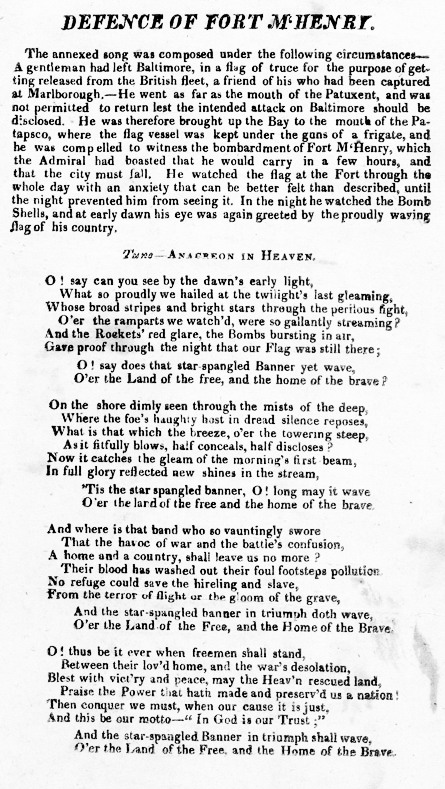
I just recently looked up Key's full text for the first time in my life, and I have to admit I was surprised at how current it is. In addition to establishing active war as a condition for knowledge of our continued existence as a country, the poem equates religious salvation with military victory so powerfully and so insidiously that it could have been commissioned by a contemporary political operative with a war to sell. (Did you note that in the first verse the words "Rockets," "Bombs," and "Flag" are all capitalized, the way the word "God" usually is?) The last verse of the original poem, The Defense of Fort McHenry, is particularly telling, and relevant to our current mindset. This is the verse that brings it all home and tells us what we're really about as a new nation; our "heav'n rescued land" has a responsibility to the God that saved it:
Then conquer me must, when our cause it is just
And this be our motto "In God is our trust;"
And the Star Spangled Banner in Triumph shall wave
O'er the land of the free and the home of the brave.
To triumph, one must triumph over someone, who then lives in defeat and subjugation. To live in triumph, one must be always in conflict, always defeating adversaries. Is this what we really want?
I know that national anthems are often militaristic, that nationalism frequently relies on defining ourselves against others and uses fear, religious fervor, and good old team spirit to exalt violence and war, but I thought that this kind of exaggerated nationalism had been discredited due to the bitter fruits it had borne in the world wars of the last century. Must we still practice exactly that brand of violent nationalism in our core national symbols?
I'm helping a friend of mine, the musicologist Mark Clague, who is doing a big project on the anniversary of the national anthem for 2011-2012, commissioning new interpretations of the song and engaging scholars on the subject. I know I'm ready for a semiological analysis on how a hymn extolling a merger of the virtues of Venus and Bacchus becomes a nationalisitic war song. We could certainly use a major taking-apart of the layers of encoded meanings of the text and music, in addition to the shifing meanings in performance and the song as a site of contested identity poitics that I believe Mark himself has embarked upon.
Right now, I'm feeling like it might be time to start thinking about a new anthem as well. How about an anthem without war? How about an anthem, heaven forbid, with a little humility? If we really are the leaders of the free world, how about an anthem that is a bit more self-assured and kindly, an anthem that might lead us to better behavior, a touch less national narcicism--one that speaks of the responsibilities of privilege, maybe, or perhaps says something about how beautiful our land is, like America the Beautiful? (That song would be fine with me as long as we ditch the last verse about the Pilgrim's feet trodding all over the natives). While we're at it, could we have a song that took a verse to somehow express some regret at the destruction of the Native American societies we perpetrated? Or maybe some sorrow over all the damage to the environment we've caused? I nominate This Land is Your Land as a candidate--every single verse of it.
Gave proof through the night that our Flag was still there"
I know I'm not the first person to notice this, but our national anthem is a war song. It enshrines violence at the heart of our national symbolic representation of ourselves. Though the melody comes from an English gentleman's-club song referencing Anacreon, the greek poet of wine, women and song, the whole poem from which The Star Spangled Banner comes is phrased as a series of questions which are all answered by flag-waving.
It is the first verse that has been most often sung since the song was adopted as the US national anthem in 1931, and in that verse, the continued existence of our country is in grave doubt. The uncertainty is underlined by the form of the verse, as it contains only one statement (quoted above) framed by two questions. The only direct affirmation in the text sets up a condition: it is only the bombs going off that prove our flag is still there. The rockets' red glare tells us that our country still exists.
This is how an historical trauma becomes a performative fact about a people--every time we meet formally as Americans, we symbolically re-enact the anxious night in 1812 that Francis Scott Key spent as a temporary prisoner on an English ship. Every sporting event, every Irish Dance competition, and every school assembly begins with us reliving the battle of Baltimore and our last-ditch redemptive victory: our fragile and feisty fledgling democracy battered but yet somehow managing to hold off the mighty forces of the nasty old English Crown. At that time, everywhere we turned lay a threat to our new freedom, but as long as the bombs were bursting in air, we knew our only recently-declared independence as a country still existed. As long as we were fighting, we knew we were alive.
Well, almost 200 years of nearly continuous war later, our flag is still there, and we are still rehearsing the mindset of a righteous and threatened country defined by war victories that can only know it exists if the bombs are going off. This is how we come to mistake the mass murder of a diffuse band of religious fanatics for something the size of the hand of the old British empire: we rehearse that substitution in our song. We take that condition of threat an insecurity redeemed through victorious war and apply it to our present almost daily by singing our song. Though the actual existence of our state is threatened by no one in the world (except maybe ourselves), we still react to all threats by regressing to the reactive state our national anthem has taught us.
I just recently looked up Key's full text for the first time in my life, and I have to admit I was surprised at how current it is. In addition to establishing active war as a condition for knowledge of our continued existence as a country, the poem equates religious salvation with military victory so powerfully and so insidiously that it could have been commissioned by a contemporary political operative with a war to sell. (Did you note that in the first verse the words "Rockets," "Bombs," and "Flag" are all capitalized, the way the word "God" usually is?) The last verse of the original poem, The Defense of Fort McHenry, is particularly telling, and relevant to our current mindset. This is the verse that brings it all home and tells us what we're really about as a new nation; our "heav'n rescued land" has a responsibility to the God that saved it:
Then conquer me must, when our cause it is just
And this be our motto "In God is our trust;"
And the Star Spangled Banner in Triumph shall wave
O'er the land of the free and the home of the brave.
To triumph, one must triumph over someone, who then lives in defeat and subjugation. To live in triumph, one must be always in conflict, always defeating adversaries. Is this what we really want?
I know that national anthems are often militaristic, that nationalism frequently relies on defining ourselves against others and uses fear, religious fervor, and good old team spirit to exalt violence and war, but I thought that this kind of exaggerated nationalism had been discredited due to the bitter fruits it had borne in the world wars of the last century. Must we still practice exactly that brand of violent nationalism in our core national symbols?
I'm helping a friend of mine, the musicologist Mark Clague, who is doing a big project on the anniversary of the national anthem for 2011-2012, commissioning new interpretations of the song and engaging scholars on the subject. I know I'm ready for a semiological analysis on how a hymn extolling a merger of the virtues of Venus and Bacchus becomes a nationalisitic war song. We could certainly use a major taking-apart of the layers of encoded meanings of the text and music, in addition to the shifing meanings in performance and the song as a site of contested identity poitics that I believe Mark himself has embarked upon.
Right now, I'm feeling like it might be time to start thinking about a new anthem as well. How about an anthem without war? How about an anthem, heaven forbid, with a little humility? If we really are the leaders of the free world, how about an anthem that is a bit more self-assured and kindly, an anthem that might lead us to better behavior, a touch less national narcicism--one that speaks of the responsibilities of privilege, maybe, or perhaps says something about how beautiful our land is, like America the Beautiful? (That song would be fine with me as long as we ditch the last verse about the Pilgrim's feet trodding all over the natives). While we're at it, could we have a song that took a verse to somehow express some regret at the destruction of the Native American societies we perpetrated? Or maybe some sorrow over all the damage to the environment we've caused? I nominate This Land is Your Land as a candidate--every single verse of it.
Saturday, January 16, 2010
Friday, January 15, 2010
This Land is [Not] Your Land
I woke up this morning to the news that a new nickel mine in the Upper Peninsula of Michigan has been approved, thus guaranteeing that another part of our state will become a slagheap, and that poisonous mine tailings will be leeching into the waters of the great lakes for many years to come. Moments later, I heard again that the power company, with the aid of the state legislature, is fighting hard for a new coal plant, thus guaranteeing that Michigan will continue to do its part to support blowing the tops off mountains and filling the streams with mud in Kentucky and West Virginia, helping to turn our planet into the overheated toxic bathtub it was apparently meant to be.
It made me remember some alternate verses I wrote to "This Land Is Your Land" when I was a kid:
As I have travelled across the nation,
it seems to me it's one big corporation--
it's all a resource for exploitation:
This land was made for industry.
You've got the soil rights, but I've got the oil rights,
where wolves ran barking, now it's for parking,
straight from the gas pump to the toxic waste dump:
This land was made for industry
At the time, these words were meant to be an exercise in bitter sarcasm, written as I watched them uproot the old woods next to the Mennonite church for a shopping mall. The euphemism of the time was that that stretch of road was being "improved," and I remember hoping in my ten-year-old mind that satire might have some kind of power to show what was really being done. Certainly if we opened our eyes to the ridiculousness of the whole enterprise, I thought, we could look at what we were doing and be ashamed.
I was wrong. We have no shame. Three decades later, the scale of the second phase of suburban sprawl in my town seems quite quaint, more like child's play. By now, the Mennonite church itself has been bulldozed for a drive-through beer store, and we've tipped so far into bizarro-world that even wild exaggerations meant to make a point about the excesses of the 1970's seem to be a statement of the obvious, more like an actual manifesto for unrestrained commercial development than an ironic inversion of our real values meant to prick our conscience. We've gotten used to feeling that the corporate juggernaut can't be stopped, even when all indications seem to be that the cost of that rampage is the very life of our planet. It's become the status quo.
Outrage doesn't seem to work, and satire has been rendered moot. Shall we go on living in complicty with this system, and take it as a given?
It made me remember some alternate verses I wrote to "This Land Is Your Land" when I was a kid:
As I have travelled across the nation,
it seems to me it's one big corporation--
it's all a resource for exploitation:
This land was made for industry.
You've got the soil rights, but I've got the oil rights,
where wolves ran barking, now it's for parking,
straight from the gas pump to the toxic waste dump:
This land was made for industry
At the time, these words were meant to be an exercise in bitter sarcasm, written as I watched them uproot the old woods next to the Mennonite church for a shopping mall. The euphemism of the time was that that stretch of road was being "improved," and I remember hoping in my ten-year-old mind that satire might have some kind of power to show what was really being done. Certainly if we opened our eyes to the ridiculousness of the whole enterprise, I thought, we could look at what we were doing and be ashamed.
I was wrong. We have no shame. Three decades later, the scale of the second phase of suburban sprawl in my town seems quite quaint, more like child's play. By now, the Mennonite church itself has been bulldozed for a drive-through beer store, and we've tipped so far into bizarro-world that even wild exaggerations meant to make a point about the excesses of the 1970's seem to be a statement of the obvious, more like an actual manifesto for unrestrained commercial development than an ironic inversion of our real values meant to prick our conscience. We've gotten used to feeling that the corporate juggernaut can't be stopped, even when all indications seem to be that the cost of that rampage is the very life of our planet. It's become the status quo.
Outrage doesn't seem to work, and satire has been rendered moot. Shall we go on living in complicty with this system, and take it as a given?
Monday, January 11, 2010
One Small Thing
A poem can take a very small thing and show you how it resonates through an entire world of experience. I’ve always thought music should do the same thing: to have as its goal making everything radiant, and to take the light that is focused on that one small thing in a poem, and to make it shine everywhere in our attention.
Friday, January 8, 2010
Monday, January 4, 2010
Note to America
These days, we think power comes from money. Instead of "God willing" we say "let the markets decide." But tonight, as I was walking in the cold, with Orion hanging over me in the southwest, and blue bands of cloud passing before the upturned horns of the setting crescent moon, I thought it might be good to remember that the only real power comes from the turning earth itself, and that all the miserable creations of our human-centric world mean nothing if they do not honor the great forces and energies of the natural world that move through us and all around us and that we have come to ignore amid our many constructions and distractions.
If we have to chase after something in this life, let it not be money and its false power. The good earth will still be spinning when the markets have crashed ten-thousand times...
If we have to chase after something in this life, let it not be money and its false power. The good earth will still be spinning when the markets have crashed ten-thousand times...
Wisdom of the Day
To be equal to our age, it is not sufficient for philosophy to retreat from spiritual vision to economics or become simply an apologist for technological innovation and investment in artificial intelligence. We need a human intelligence to express a culture equal to our present condition.
William Irwin Thompson
William Irwin Thompson
Saturday, January 2, 2010
Inviting the gods
After yet another night of very accomplished music that was utterly free from yearning, I find myself thinking about Bali. I was taught that in that part of Indonesia the gods are the true audience for music, not people. I learned that musical ceremonies exist to invite the gods to be present, and to call forth and satisfy the needs of invisible powers.
I go to a lot of concerts, so I listen to a lot of live music that is well-made and beautifully played, but I find that there are far more crowd-pleasers than god-pleasers. So much music seems to be made merely for the people, and I become convinced of one thing: for me, music that doesn’t somehow strive to invite a sacred presence just isn’t enough. All the technique and titillation aimed at garnering a standing ovation just seems empty without a sense of courting the sacred—it could be hilariously sacred, dark cathedral sacred, ecstatic sacred, deep-in-the-woods sacred, oddly sacred, but geeze-louise, so often it seems like not only was the music not written for the gods, but they aren’t even invited to come listen. So often it seems as if no one on stage wants anything from the music but their own mastery and our admiration.
So here is what I’m asking: what if we all agree not to waste our wild and precious lifetimes with the blank nonsense of merely desirable, semi-automatic, or even technically perfect-but-safe art? Could we musicians individually or collectively decide to reject a culture that constantly tempts us to orient our whole expression toward empty accomplishment? Could we please just pause in our busy days of achievement to call the gods forth into our homes and our concert halls, and to beseech them with every breath of our music-making?
I go to a lot of concerts, so I listen to a lot of live music that is well-made and beautifully played, but I find that there are far more crowd-pleasers than god-pleasers. So much music seems to be made merely for the people, and I become convinced of one thing: for me, music that doesn’t somehow strive to invite a sacred presence just isn’t enough. All the technique and titillation aimed at garnering a standing ovation just seems empty without a sense of courting the sacred—it could be hilariously sacred, dark cathedral sacred, ecstatic sacred, deep-in-the-woods sacred, oddly sacred, but geeze-louise, so often it seems like not only was the music not written for the gods, but they aren’t even invited to come listen. So often it seems as if no one on stage wants anything from the music but their own mastery and our admiration.
So here is what I’m asking: what if we all agree not to waste our wild and precious lifetimes with the blank nonsense of merely desirable, semi-automatic, or even technically perfect-but-safe art? Could we musicians individually or collectively decide to reject a culture that constantly tempts us to orient our whole expression toward empty accomplishment? Could we please just pause in our busy days of achievement to call the gods forth into our homes and our concert halls, and to beseech them with every breath of our music-making?
Friday, October 2, 2009
administrative gardening
I think about my work as an administrator and teacher in a University School of Music–(fostering community, building trusting relationships, continuing ideals)–as something akin to an organic gardener or farmer's relationship to the land. The short-term gains to be had from treating the land or the institution as a set of resources from which to draw personal gain (the equivalent of jacking the whole operation up on chemical fertilizers) are outweighed by the long-term costs of such exploitative extraction. Instead of taking everything we can get from the soil of our institution(s), we need to work to enrich the land, build up the layers of fertile topsoil with care, attention, kindness, generosity, and attention. With love and commitment, even. I'm not sure about a metaphor that matches hard caring work in a University with compost, but there it is. Stewardship and selflessness enrich community and continue institutions. Selfishness, elitism, hierarchy, prestige-mongering, and grandstanding destroy them.
Wednesday, May 6, 2009
Wisdom of the day
"'Every man for himself' is a doctrine for a feeding frenzy or for a panic in a burning nightclub, appropriate for sharks or hogs or perhaps a cascade of lemmings. A society wishing to endure must speak the language of care-taking, faith-keeping, kindness, neighborliness, and peace. That language is another precious resource that cannot be 'privatized.'"
Wendell Berry
The Way of Ignorance
"Rugged Individualism"
Wendell Berry
The Way of Ignorance
"Rugged Individualism"
Wednesday, January 28, 2009
Wisdom of the Day
"Focusing your life solely on making a buck shows a certain poverty of ambition. It asks too little of yourself. Because it's only when you hitch your wagon to something larger than yourself that you realize your true potential."
Barack Obama-quoted in the Upaya Zen Center newsletter
Barack Obama-quoted in the Upaya Zen Center newsletter
Friday, January 16, 2009
A report on the upwelling of memory despite general alienation from the place of my childhood:
Dayton Ohio, summer 2006
I haven’t lived here in 25 years. And yet I know this place as I ride along the sidewalks, floating along in the twilight. I know the order of the houses: heading from the narrow treeless lots of the 90’s duplexes by the highway, past the old Friends Meeting House, past the single-story brick ranch houses along the main road, and into the plats: curved arrays of similar split-level brick-and-timber 1970s constructions with the two-car garages on one end, and the steps to their raised entryways on the other.
I pass two homes I know to have been marked recently by grief: that of my high-school art teacher dead this week of a massive heart attack at age 62, looking just like my father in his newspaper photo, and that of my dear old neighbor woman, dead within 36 hours after receiving the diagnosis of the cancer she had known in her fears for years but feared to face. I pass the house of the girl who was the prom date of my friend, who brought her little brother along on our double-date day-trip to an amusement park in order to keep him from getting beaten up by her parents in her absence. I pass the houses of childhood loves (Lisa Miller, this means you), and old tormentors (Darin Cook, Mike York, and Mike Haney, this means you). I pass through the old farm fields and woods that were all slowly turned into housing developments almost identical the one I lived in. I ride up and down the huge hills of my memory, only to find them diminished in size by their age, worn down by the years and sagging slightly, no longer impressive or fearsome. I imagine I could easily pedal up them now without panting and struggling; I might even skateboard down them without falling and ripping the flesh off my legs. I see the bare concrete drainage ditch that they replaced our enchanted creek with, now silted and overgrown, surrounded by large trees, except for one stretch where an unfortunately conscientious homeowner has assiduously cleared all the brush and maintained its original sterility. Up the way though, you can hear that the frogs have returned, and made the stream their home again.
The pond where I fished (and where Mike Patko broke through the ice) is gone, as are all its catfish and bluegills and tadpoles and snakes, but the Swafford’s house is still the Swafford’s house, its front yard still filled with lawn chatchkes. The houses that always had meticulously-tended lawns (“I like to cut on the diagonal—but ya gotta vary your cutting pattern—it’s better for the grass”) still have meticulously-tended lawns. The two towering beeches that served as spiritual anchors in our youthful cosmology are both gone, but a tiny corner of the woods that they commanded remains—right there is the sacred nook of boulders in the trees we called glenwood, dropped by glacier, river, or moved there by the railroad cut. When I was little we used to pick through the rubble for signs and omens. We believed in magic then, and somehow we managed to feel the power leaking up through the earth in those rocky hidden places. We gave them all names like “Witch’s lair” and “Warlock’s will” and “The Toy Fort”, and I still carry scars on my left knee from falling into the scree while jumping from stone to stone to stone in the gathering dark as a storm approached one summer night.
There are remnants of the dirt trails I used to zoom along in the cool dampness of the shade before bursting back out into the dusty bowl of the open field¬, blasting full-speed on my banana-seat bike with the headlight, horn and speedometer, but no helmet, of course. I can still smell the mud, and I can still see the map we made of our domain with curvy lines of yarn glued onto a big yellowed sheet of sketch paper. I remember I wanted to map out all the sticker bushes—they were our sworn enemies--but my sister countered that they were not permanent features of the landscape. We thought that we were permanent though, maybe because in those days one summer lasted an eternity.
We believed that one summer when the lightning bugs lit up the black wall of the trees like a carnival ride would last forever—a permanent feature. We thought the donkeys that kept us awake, the spooky call of the owls, the corn we “found” and the archaic mysteries hidden in the abandoned barn—those were permanent features. Everything we felt the magic streaming through, that we thought would stay.
Well, the high-tension powerlines stayed, and they’ve gotten more diligent about cutting down every last living thing that grows beneath them these days. The brick red placards that used to read danger high voltage! are still affixed there some twenty feet off the ground, but there are no discernable letters to read anymore. And my old house—my old house is still there. The decorative wrought iron my mother swore was going to pull down the whole front wall is still there. The small ginko tree is still patiently growing in the front yard, and the willow my mother swore was dead 30 years ago still lives at the top of the hill in the back. It all looks the same—same mailbox, same railing. Same windows. My mother’s roses still bloom on the south end of the house, and the pyrocantha still climbs up the brick of the north (thorn bushes on either side, it strikes me now…). From way down the hill, I can still see the patio cover my father built by himself 32 years ago without a permit, (the one my mother swore would rot and fall down or devalue the house). Looking across the field and through the trees I can still see the television flicker right where it always used to be. In my mind I can see the wood grain on the door to the garage, the satin reflection of the Christmas tree in the kitchen door, and the colored glass panes we put up on either side of the foyer after our dog tore up the side curtains scratching and nosing to see out.
I mowed that grass, writing songs in my head and imagining some kind of lawn-mowing competition/race that would combine speed with style points for crazy designs. I lay on that hill in adolescent torpor, reading and dreaming and pining. Hoping. Wishing for deliverance from the sadness and torment of my own mind, from the emptiness and hurt that I could not at that time even begin to know the dimensions of.
Many years later, after my father’s stroke, when I returned to my youthful habit of taking walks in the wee hours of the night (and getting harassed by local cops again too), I remember looking at my old house and wondering at how much like a boat it was, and how miraculous it was that it could even stay afloat on such rough waters. Such a small craft, really; when you took a good look at it (docked for the night as it was), it was impossible to imagine how on earth it managed to hold so much pain.
Tonight when I look at it up there on its hill, I try to imagine I can still see a skinny boy climbing out of that back window to sit on the roof and savor the last bit of the sunset. I try to catch myself flickering through from my past, but someone has a backyard spotlight turned on, shining right through the woods and into my eyes—it seems to identify me as a threat (an interrogator’s lamp). Then one of the countless snippy little dogs around takes up yapping at my presence, and I can’t quite conjure up my old self.
It’s getting dark now. My reflector fell off my bike on the way here, and now my batteries have died on my front light, so I can’t see where I’m going, and am not visible to oncoming traffic. I’ll have to take the roundabout way all the way back to my parent’s new house, where my ailing father sits in front of the TV waiting. There are sidewalks all along here, but you can zoom along them in the dark for miles without any chance of running into anyone, even if you have no idea what’s up ahead. In the end, the feelings come, even though I can’t imagine myself as real here in this moment, just sailing along in the shadows past the rows of darkened houses…
I haven’t lived here in 25 years. And yet I know this place as I ride along the sidewalks, floating along in the twilight. I know the order of the houses: heading from the narrow treeless lots of the 90’s duplexes by the highway, past the old Friends Meeting House, past the single-story brick ranch houses along the main road, and into the plats: curved arrays of similar split-level brick-and-timber 1970s constructions with the two-car garages on one end, and the steps to their raised entryways on the other.
I pass two homes I know to have been marked recently by grief: that of my high-school art teacher dead this week of a massive heart attack at age 62, looking just like my father in his newspaper photo, and that of my dear old neighbor woman, dead within 36 hours after receiving the diagnosis of the cancer she had known in her fears for years but feared to face. I pass the house of the girl who was the prom date of my friend, who brought her little brother along on our double-date day-trip to an amusement park in order to keep him from getting beaten up by her parents in her absence. I pass the houses of childhood loves (Lisa Miller, this means you), and old tormentors (Darin Cook, Mike York, and Mike Haney, this means you). I pass through the old farm fields and woods that were all slowly turned into housing developments almost identical the one I lived in. I ride up and down the huge hills of my memory, only to find them diminished in size by their age, worn down by the years and sagging slightly, no longer impressive or fearsome. I imagine I could easily pedal up them now without panting and struggling; I might even skateboard down them without falling and ripping the flesh off my legs. I see the bare concrete drainage ditch that they replaced our enchanted creek with, now silted and overgrown, surrounded by large trees, except for one stretch where an unfortunately conscientious homeowner has assiduously cleared all the brush and maintained its original sterility. Up the way though, you can hear that the frogs have returned, and made the stream their home again.
The pond where I fished (and where Mike Patko broke through the ice) is gone, as are all its catfish and bluegills and tadpoles and snakes, but the Swafford’s house is still the Swafford’s house, its front yard still filled with lawn chatchkes. The houses that always had meticulously-tended lawns (“I like to cut on the diagonal—but ya gotta vary your cutting pattern—it’s better for the grass”) still have meticulously-tended lawns. The two towering beeches that served as spiritual anchors in our youthful cosmology are both gone, but a tiny corner of the woods that they commanded remains—right there is the sacred nook of boulders in the trees we called glenwood, dropped by glacier, river, or moved there by the railroad cut. When I was little we used to pick through the rubble for signs and omens. We believed in magic then, and somehow we managed to feel the power leaking up through the earth in those rocky hidden places. We gave them all names like “Witch’s lair” and “Warlock’s will” and “The Toy Fort”, and I still carry scars on my left knee from falling into the scree while jumping from stone to stone to stone in the gathering dark as a storm approached one summer night.
There are remnants of the dirt trails I used to zoom along in the cool dampness of the shade before bursting back out into the dusty bowl of the open field¬, blasting full-speed on my banana-seat bike with the headlight, horn and speedometer, but no helmet, of course. I can still smell the mud, and I can still see the map we made of our domain with curvy lines of yarn glued onto a big yellowed sheet of sketch paper. I remember I wanted to map out all the sticker bushes—they were our sworn enemies--but my sister countered that they were not permanent features of the landscape. We thought that we were permanent though, maybe because in those days one summer lasted an eternity.
We believed that one summer when the lightning bugs lit up the black wall of the trees like a carnival ride would last forever—a permanent feature. We thought the donkeys that kept us awake, the spooky call of the owls, the corn we “found” and the archaic mysteries hidden in the abandoned barn—those were permanent features. Everything we felt the magic streaming through, that we thought would stay.
Well, the high-tension powerlines stayed, and they’ve gotten more diligent about cutting down every last living thing that grows beneath them these days. The brick red placards that used to read danger high voltage! are still affixed there some twenty feet off the ground, but there are no discernable letters to read anymore. And my old house—my old house is still there. The decorative wrought iron my mother swore was going to pull down the whole front wall is still there. The small ginko tree is still patiently growing in the front yard, and the willow my mother swore was dead 30 years ago still lives at the top of the hill in the back. It all looks the same—same mailbox, same railing. Same windows. My mother’s roses still bloom on the south end of the house, and the pyrocantha still climbs up the brick of the north (thorn bushes on either side, it strikes me now…). From way down the hill, I can still see the patio cover my father built by himself 32 years ago without a permit, (the one my mother swore would rot and fall down or devalue the house). Looking across the field and through the trees I can still see the television flicker right where it always used to be. In my mind I can see the wood grain on the door to the garage, the satin reflection of the Christmas tree in the kitchen door, and the colored glass panes we put up on either side of the foyer after our dog tore up the side curtains scratching and nosing to see out.
I mowed that grass, writing songs in my head and imagining some kind of lawn-mowing competition/race that would combine speed with style points for crazy designs. I lay on that hill in adolescent torpor, reading and dreaming and pining. Hoping. Wishing for deliverance from the sadness and torment of my own mind, from the emptiness and hurt that I could not at that time even begin to know the dimensions of.
Many years later, after my father’s stroke, when I returned to my youthful habit of taking walks in the wee hours of the night (and getting harassed by local cops again too), I remember looking at my old house and wondering at how much like a boat it was, and how miraculous it was that it could even stay afloat on such rough waters. Such a small craft, really; when you took a good look at it (docked for the night as it was), it was impossible to imagine how on earth it managed to hold so much pain.
Tonight when I look at it up there on its hill, I try to imagine I can still see a skinny boy climbing out of that back window to sit on the roof and savor the last bit of the sunset. I try to catch myself flickering through from my past, but someone has a backyard spotlight turned on, shining right through the woods and into my eyes—it seems to identify me as a threat (an interrogator’s lamp). Then one of the countless snippy little dogs around takes up yapping at my presence, and I can’t quite conjure up my old self.
It’s getting dark now. My reflector fell off my bike on the way here, and now my batteries have died on my front light, so I can’t see where I’m going, and am not visible to oncoming traffic. I’ll have to take the roundabout way all the way back to my parent’s new house, where my ailing father sits in front of the TV waiting. There are sidewalks all along here, but you can zoom along them in the dark for miles without any chance of running into anyone, even if you have no idea what’s up ahead. In the end, the feelings come, even though I can’t imagine myself as real here in this moment, just sailing along in the shadows past the rows of darkened houses…
Monday, December 1, 2008
Against the Virtues of Classification
In the spring of 2008 I took a long walk with my friend the poet Keith Taylor at the headwaters of the Huron river. It was a magical place, and I was so grateful to him for taking me there. I ended up writing a piece about it.
But we had a little gentle disagreement about the virtues of naming–here’s my side, in verse:
Against the Virtues of Classification
(for Keith Taylor)
“If I were a better person, I would know the name of that…” KT
It should be no great shame to bear.
I can’t name maidenhair,
cinnamon, or fiddlehead.
I rhyme slough with enough,
consistently failing
to distinguish marsh from fen,
shagbark from hophornbeam.
I can’t tell my alders from my elders,
and my maples may be muddled,
but in the Spring,
when both eyes turn on the strings of one furry spiral,
and my mind floods
with that singular moment of uncurling,
what I know
is not called fern.
But we had a little gentle disagreement about the virtues of naming–here’s my side, in verse:
Against the Virtues of Classification
(for Keith Taylor)
“If I were a better person, I would know the name of that…” KT
It should be no great shame to bear.
I can’t name maidenhair,
cinnamon, or fiddlehead.
I rhyme slough with enough,
consistently failing
to distinguish marsh from fen,
shagbark from hophornbeam.
I can’t tell my alders from my elders,
and my maples may be muddled,
but in the Spring,
when both eyes turn on the strings of one furry spiral,
and my mind floods
with that singular moment of uncurling,
what I know
is not called fern.
Emotion Permitted/Emotion Reduced
Some time ago I participated in a worthy musicological experiment undertaken by Judith Becker titled Emotion permitted/Emotion reduced. Subjects were chosen who self-reported strong emotional responses to music; they were asked to pick out two recordings they found especially moving and listen to them while having their galvanic skin response monitored. This is like taking a lie detector test, only there are no grilling questions, and you get to listen to music. Subjects were asked to let their emotions flow in one listening, and to try to turn off their emotional responses in a second instance.
I love listening to music, and was happy to do so, even with electrodes placed on my fingertips. But I was nervous.
I was pretty sure I could manage the emotion permitted part. I believe that I am extremely fluent in permitting feeling to arise; as a creative artist it is my stock-in-trade to preserve the outlines of emotional experience within myself in order to call them up again and again over the long course of creating a work. I am a composer, and I have come to believe that the emotional play of forces created by sound is the real content of music, and that this play of emotional energies is (even more than sound) the material that I am working with. I subscribe to the idea that musical art is indeed the act of “creating magic through emotion.” (Damasio 1999: 50).
Capturing a feeling and exploring the dimensions of it over time requires a level of skill with emotive experience that does require a certain distance, but I was absolutely convinced that I was not equipped to complete the second part of the experiment: emotion reduced. Reflection upon an experienced emotional state is not the same thing as willful reduction of it by any means.
Even though I wasn’t sure I could do it, I had little doubt that it would be easy to find many subjects with tremendous expertise in the reduction of emotional response.
Can you do it?
When emotion arises in you, can you shut it off? Can you tell your skin not to become charged and hot when you see the child mangled on TV? Or feel no sense of dread when you sense the explosion approaching because the ominous underscoring comes up in the war movie?
I began to wonder:
Haven’t we as a society all been preparing for the second half of this experiment for decades by learning how to shut ourselves off from emotionally-charged stimuli? Popular music presents us with an aggressive wall of sound that we practice ignoring—anything that requires engaged attention hasn’t got a chance of generating a spark of feeling in the vast majority of us Americans. (A rap song I heard on network television once describes a brutally murdered dismembered female body in the trunk of a car; it seems we are not horrified enough by this to recognize and reject a play to our most odious violent impulses being used as a cheap thrill.) It is no surprise to me that we can make ourselves immune to the emotional pull of music if we practice not-responding so assiduously to murder, war, and all kinds of numbing violence every night as we watch TV.
No, no surprise there. We see all these horrible things happen to our fellow humans every day on television, and bathe ourselves in noisy environments that require us to tune out, a rigorous training in callousness and lack of feeling. Our senses have been dulled, our feeling blunted, and our compassion stunted by the onslaught of our cruel entertainments. I guess that is why classical music is useless to most of us now—it does not quite get up to the thrill level we expect; the dynamic range of its emotional life, (to say nothing of the sustained attention it requires) cannot begin to approximate the quick brutality of our cinema and the law-enforcement morality plays we daily ingest on television.
In a society where the routine exposure to graphic representations of murder, rape and violent death of all kinds is taken as the norm, it is abnormal to be sensitive. The quality of sensitivity becomes stigmatized as an intolerable weakness, especially in males, who above all are supposed to be “tough” (which translates as inured to all suffering). So according to this logic, anyone who is emotionally sensitive to another’s suffering is abnormal: sensitivity comes to be seen as un-American.
But without sensitivity, there can be no interoception: the ability to sense our own internal mental and physical states. And without interoception, there can be no compassion. In other words, we cannot feel for others unless we can feel for ourselves. If there is no compassion, we are lost in self-referential childish grabbing at rewards without any thought of our companions on this planet, or any regard for the consequences of our selfish or even violent actions.
Sometimes it seems that large swaths of our popular culture have come to constitute a kind of abuse we subject ourselves to in order to hold down natural emotional responses and “toughen ourselves up.” Over-exposure to media sex and violence doesn’t make us stronger or sexier, but it certainly does make us less sensitive and makes violence more present to us, more easily imaginable. By these means we are engaging in a mass exercise aimed at squashing our humanity. I believe that the collective weight of our suppressed emotional responses is beginning to come out as rage and disease, as violence expressed in so many ways as to be uncountable.
I love listening to music, and was happy to do so, even with electrodes placed on my fingertips. But I was nervous.
I was pretty sure I could manage the emotion permitted part. I believe that I am extremely fluent in permitting feeling to arise; as a creative artist it is my stock-in-trade to preserve the outlines of emotional experience within myself in order to call them up again and again over the long course of creating a work. I am a composer, and I have come to believe that the emotional play of forces created by sound is the real content of music, and that this play of emotional energies is (even more than sound) the material that I am working with. I subscribe to the idea that musical art is indeed the act of “creating magic through emotion.” (Damasio 1999: 50).
Capturing a feeling and exploring the dimensions of it over time requires a level of skill with emotive experience that does require a certain distance, but I was absolutely convinced that I was not equipped to complete the second part of the experiment: emotion reduced. Reflection upon an experienced emotional state is not the same thing as willful reduction of it by any means.
Even though I wasn’t sure I could do it, I had little doubt that it would be easy to find many subjects with tremendous expertise in the reduction of emotional response.
Can you do it?
When emotion arises in you, can you shut it off? Can you tell your skin not to become charged and hot when you see the child mangled on TV? Or feel no sense of dread when you sense the explosion approaching because the ominous underscoring comes up in the war movie?
I began to wonder:
Haven’t we as a society all been preparing for the second half of this experiment for decades by learning how to shut ourselves off from emotionally-charged stimuli? Popular music presents us with an aggressive wall of sound that we practice ignoring—anything that requires engaged attention hasn’t got a chance of generating a spark of feeling in the vast majority of us Americans. (A rap song I heard on network television once describes a brutally murdered dismembered female body in the trunk of a car; it seems we are not horrified enough by this to recognize and reject a play to our most odious violent impulses being used as a cheap thrill.) It is no surprise to me that we can make ourselves immune to the emotional pull of music if we practice not-responding so assiduously to murder, war, and all kinds of numbing violence every night as we watch TV.
No, no surprise there. We see all these horrible things happen to our fellow humans every day on television, and bathe ourselves in noisy environments that require us to tune out, a rigorous training in callousness and lack of feeling. Our senses have been dulled, our feeling blunted, and our compassion stunted by the onslaught of our cruel entertainments. I guess that is why classical music is useless to most of us now—it does not quite get up to the thrill level we expect; the dynamic range of its emotional life, (to say nothing of the sustained attention it requires) cannot begin to approximate the quick brutality of our cinema and the law-enforcement morality plays we daily ingest on television.
In a society where the routine exposure to graphic representations of murder, rape and violent death of all kinds is taken as the norm, it is abnormal to be sensitive. The quality of sensitivity becomes stigmatized as an intolerable weakness, especially in males, who above all are supposed to be “tough” (which translates as inured to all suffering). So according to this logic, anyone who is emotionally sensitive to another’s suffering is abnormal: sensitivity comes to be seen as un-American.
But without sensitivity, there can be no interoception: the ability to sense our own internal mental and physical states. And without interoception, there can be no compassion. In other words, we cannot feel for others unless we can feel for ourselves. If there is no compassion, we are lost in self-referential childish grabbing at rewards without any thought of our companions on this planet, or any regard for the consequences of our selfish or even violent actions.
Sometimes it seems that large swaths of our popular culture have come to constitute a kind of abuse we subject ourselves to in order to hold down natural emotional responses and “toughen ourselves up.” Over-exposure to media sex and violence doesn’t make us stronger or sexier, but it certainly does make us less sensitive and makes violence more present to us, more easily imaginable. By these means we are engaging in a mass exercise aimed at squashing our humanity. I believe that the collective weight of our suppressed emotional responses is beginning to come out as rage and disease, as violence expressed in so many ways as to be uncountable.
Monday, November 24, 2008
Last Night at Yaddo
Bathroom/Yaddo/Spring 2006
(a meditation on the eve of departure)
I imagine in the summertime
when these grooved wall boards were painted white
that the wood was pressed in close at the joints,
swollen with wet heat.
But now it’s late March.
After three dry months the panels
are pulling apart right next to the toilet paper roll
leaving a translucent skin stretched across the void,
as if it were trying to hold on,
clinging to the part of itself that is departing.
It’s almost irresistible, like fresh ice on puddles,
and I can’t believe no one else
has yet sliced along that edge with the tip of a fingernail
as they sat here
just to have the satisfaction of that brittle tearing sound–
rending those last few tendrils of attachment to what is shrinking so slowly away.
~ ~ ~ ~ ~
Here's a simple slow air I wrote a couple years ago; it's a farewell for a friend's last night at Yaddo, the artist's colony in Saratoga NY...
~
Tuesday, November 18, 2008
two thoughts on winter
The cold has descended. The first snow has piled itself on the steps and the ground has frozen. Here are two thoughts about winter: a poem I wrote a few years ago, and a new fiddle tune called "The Early Dark."
I.
Winter, 2006
One degree costs fifty dollars this year:
that’s the price to raise the thermostat
for thirty short days
up to 64,
where it seems
I live surrounded by a comfort
unknown to me at 63.
It’s only a temporary corrective.
The truth is
we belong to the cold.
We are its subjects,
and must eventually render unto it
what has always been due.
I believe that this is how it goes:
everything growing colder and colder,
each notch of heat in turn
becoming too dear–
until all the toasting of walnuts,
and all those steaming cups of tea
finally offer us no relief–
then at last
we fall to room temperature ourselves
and can’t buy even one degree of warmth anymore forever.
II.

I.
Winter, 2006
One degree costs fifty dollars this year:
that’s the price to raise the thermostat
for thirty short days
up to 64,
where it seems
I live surrounded by a comfort
unknown to me at 63.
It’s only a temporary corrective.
The truth is
we belong to the cold.
We are its subjects,
and must eventually render unto it
what has always been due.
I believe that this is how it goes:
everything growing colder and colder,
each notch of heat in turn
becoming too dear–
until all the toasting of walnuts,
and all those steaming cups of tea
finally offer us no relief–
then at last
we fall to room temperature ourselves
and can’t buy even one degree of warmth anymore forever.
II.

Sunday, November 16, 2008
choose the means, not the ends
As Americans, we are constantly being trained to be driven by desire--so many of us believe that in order to exist in the world, we must strive to get ahead: to decide what it is we want and lock our attention on the goal of winning the object of our desire. We are encouraged to use whatever means are necessary to get what we want.
As a result, many venerated successes have been achieved in this world through destructive means. Sometimes it seems like we are so addicted to getting what we want that we only see the getting, and close our eyes to the trail of destruction our grasping leaves behind. Even achieving something good is marred if it is reached by what Buddhists call "unskillful means." I would say that even spiritual enlightenment is darkened and stained if it is reached through cruelty and violence, either to others or to the sad old bag of bones that was its vehicle.
Let use choose our means before our ends. We will serve ourselves and others far better in the long run if we first decide on how we are going to go about living as a matter of informed principle, and then accept what comes of it. Instead of latching onto desire and allowing it to push us toward unethical actions, let us first choose moral, compassionate caring, even loving means, and then follow them where they take us.
As a result, many venerated successes have been achieved in this world through destructive means. Sometimes it seems like we are so addicted to getting what we want that we only see the getting, and close our eyes to the trail of destruction our grasping leaves behind. Even achieving something good is marred if it is reached by what Buddhists call "unskillful means." I would say that even spiritual enlightenment is darkened and stained if it is reached through cruelty and violence, either to others or to the sad old bag of bones that was its vehicle.
Let use choose our means before our ends. We will serve ourselves and others far better in the long run if we first decide on how we are going to go about living as a matter of informed principle, and then accept what comes of it. Instead of latching onto desire and allowing it to push us toward unethical actions, let us first choose moral, compassionate caring, even loving means, and then follow them where they take us.
Friday, November 14, 2008
The Gesture of Meaning
When I was younger, I believed that the act of creating meaning would save us. There was relief in the movement toward beauty, and a sense of completeness in following the urge to voice longing and hurt. I had a physical sense of sacredness rising up behind those upwellings of emotion, illuminating the world around me. It seemed clear that by practicing that movement of release and rising beneficence in my creative work, I might be able to learn to live in accordance with it. I hoped others (someone, somewhere) could receive the beam I was sending out, and undertake to enact the gesture of meaning that had filled me by following the trace left in my music.
As I got older, though, I found a mercenary strain abiding in the professional music world working to convince me that it was more important to be eminent than to be honest, more important to have wide distribution than to communicate meaning, and far more important to generate measurable prestige than to reach for some kind of truth. Within that worldview, it follows that creating an image to push over on the crowd is primary, and connecting with individual human hearts is a secondary pursuit at best, something that has been devalued almost to the point of being worthless.
But in that worthlessness is another kind of salvation. To be worthless is to be beyond value, to exist outside of the system of economic objects, in which everything is collapsed down to its exchange value, it’s media fizz or institutional rank. We rank every single person at my university music school every year from most important to least, and let me assure you, those rankings are based almost exclusively on external validation and prestige. In such a climate, it starts to feel like a radical challenge to the prevailing moral landscape to believe in art as anything more than a means toward self-aggrandizement. Yet only if our art is born from compassion, from the recognition that every single soul is equally important will we be enlightening our society instead of putting it to sleep with illusions.
If moral values can be communicated through behavior, then they can be communicated through art, and artists can therefore influence us in our own moral convictions. It is by participating in the root assumptions presented in a work of art that we are altered–by tracing the source and the qualities of its gestures, and by turning our attention to that which it is gesturing toward. Every act, every attempt at communication is generated from a ground of assumptions about what matters. Every artistic statement puts forth a stream of actions and associations that flow from that field, and serve to represent it in the experience of the creator as well as the receiver. Meaning is something we do. The world invites us to burn up our attachment to our own importance and to dissolve into a state in which everyone and everything shines with sacredness. This is the gesture of meaning.
As I got older, though, I found a mercenary strain abiding in the professional music world working to convince me that it was more important to be eminent than to be honest, more important to have wide distribution than to communicate meaning, and far more important to generate measurable prestige than to reach for some kind of truth. Within that worldview, it follows that creating an image to push over on the crowd is primary, and connecting with individual human hearts is a secondary pursuit at best, something that has been devalued almost to the point of being worthless.
But in that worthlessness is another kind of salvation. To be worthless is to be beyond value, to exist outside of the system of economic objects, in which everything is collapsed down to its exchange value, it’s media fizz or institutional rank. We rank every single person at my university music school every year from most important to least, and let me assure you, those rankings are based almost exclusively on external validation and prestige. In such a climate, it starts to feel like a radical challenge to the prevailing moral landscape to believe in art as anything more than a means toward self-aggrandizement. Yet only if our art is born from compassion, from the recognition that every single soul is equally important will we be enlightening our society instead of putting it to sleep with illusions.
If moral values can be communicated through behavior, then they can be communicated through art, and artists can therefore influence us in our own moral convictions. It is by participating in the root assumptions presented in a work of art that we are altered–by tracing the source and the qualities of its gestures, and by turning our attention to that which it is gesturing toward. Every act, every attempt at communication is generated from a ground of assumptions about what matters. Every artistic statement puts forth a stream of actions and associations that flow from that field, and serve to represent it in the experience of the creator as well as the receiver. Meaning is something we do. The world invites us to burn up our attachment to our own importance and to dissolve into a state in which everyone and everything shines with sacredness. This is the gesture of meaning.
Wednesday, November 12, 2008
The Cost of Prosperity
In spring 2006, I was staying at the artist’s colony Yaddo, which is on the estate of the 19th-century venture-capitalist and railroad baron Spencer Trask. On the shelf in his wife Katrina's room, I found some prophetic words about our current cultural situation in an old book titled Our Business Civilization: Some Aspects of American Culture, by James Truslow Adams. I was a little shocked to find such a clear-thinking criticism of the extent to which American society is driven by business concerns there in the study of the wife of a great industrialist! I felt deep sympathy with the writer’s sentiments, and found it remarkable how current the ideas seemed, in spite of the fact that it was published in 1929. Here is a sampling:
“Overwhelmed by the material advance made in the past five decades or so, and by the vast amount of Pollyanna literature with which we are flooded by politicians and business executives with axes to grind, we are apt to lose sight of the law of compensation and to think of all change as unalloyed improvement.”
“Change may or may not be “progress” but whether it is nor not it is bound to involve compensatory losses.” p 35
“It is obvious that with a national income of even ninety billions, a hundred and twenty million people cannot buy everything. Some things have to go if we are to have new things constantly and pay double or treble for the old.” p48
In a chapter entitled To ‘Be’ and To ‘Do,’Adams quotes Matthew Arnold’s description of culture as “a harmonious expansion of all the powers which make the beauty and worth of human nature.” He goes on to say: “This is far removed from giving the degree of Bachelor of Arts to a student who has learned how to truss and dress poultry or has compassed the mysteries of how to sell real estate and run an apartment house. Of course, life is short, and getting rich is long–or may be. Many people who go to college to-day, aside from their lack of desire for education, have no time for it, because it does not lead immediately to ‘power’…”
pp169-170
Adams also cites a foreign critic of American life who says “ one feeling he always had here was that all our goods were in our shop windows and there was nothing behind.” Adams writes in response” “We are so busy doing that we have no time to be. …at present what we need above all else in America is education–not the infinitely variegated supply of courses that make a college catalogue look like Sears, Roebucks, but a liberal education that will enable us to create a scale of values for our experiences and to take a philosophical attitude toward the complex reality about us.” …is it not time that we stopped marking down all our spiritual goods to the price that the lowest in the cultural scale can pay?”
We’ve had ample opportunity in the eighty years since those words were written to see many of the other costs of our prosperity: a citizenry disenfranchised and apathetic, our political process reduced to the lowest fear-mongering and the basest manipulation of the electorate, the concentration of power in the hands of large corporations, the privileging of profit above all human values, and the celebration of unchecked greed as the motive force of capitalist democracy. This is not to mention the continuing destruction of the planet upon which we live, and the countless lives destroyed in our wars. These are the real costs of our prosperity.
Our own integrity as humans has been tossed aside as an encumbrance in the race to get more money, more fame, more prestige, more stuff. We have gutted our culture and our civil society and our human relationship to each other in order to get more. Now, we are in the midst of yet another global economic crisis triggered by our own desperate unprincipled grasping and denial. It is not so dissimilar from the one that loomed when James Truslow Adams was writing, and we find that we have forgotten the hard lessons that the great depression taught us.
In spite of the campaign-slogan Hope offered by president-elect Obama, I can’t help thinking it will be hard to undo the damage: we’ve had over thirty years worth of dismantling society in favor of an “every man for himself” business model. In our business civilization, we don’t see fellow citizens and neighbors around us, only competitors to be defeated. But when everyone is driven only by their own hunger, blindly pursuing selfish short-term gain, they end up eating the system that sustains us all. If there is any real hope for us out there, we will have to compost the corporate marketplace nightmare worldview that has been driving our society for a long, long time now, and rebuild our values and our connections to each other based on something other than money and commerce.
“Overwhelmed by the material advance made in the past five decades or so, and by the vast amount of Pollyanna literature with which we are flooded by politicians and business executives with axes to grind, we are apt to lose sight of the law of compensation and to think of all change as unalloyed improvement.”
“Change may or may not be “progress” but whether it is nor not it is bound to involve compensatory losses.” p 35
“It is obvious that with a national income of even ninety billions, a hundred and twenty million people cannot buy everything. Some things have to go if we are to have new things constantly and pay double or treble for the old.” p48
In a chapter entitled To ‘Be’ and To ‘Do,’Adams quotes Matthew Arnold’s description of culture as “a harmonious expansion of all the powers which make the beauty and worth of human nature.” He goes on to say: “This is far removed from giving the degree of Bachelor of Arts to a student who has learned how to truss and dress poultry or has compassed the mysteries of how to sell real estate and run an apartment house. Of course, life is short, and getting rich is long–or may be. Many people who go to college to-day, aside from their lack of desire for education, have no time for it, because it does not lead immediately to ‘power’…”
pp169-170
Adams also cites a foreign critic of American life who says “ one feeling he always had here was that all our goods were in our shop windows and there was nothing behind.” Adams writes in response” “We are so busy doing that we have no time to be. …at present what we need above all else in America is education–not the infinitely variegated supply of courses that make a college catalogue look like Sears, Roebucks, but a liberal education that will enable us to create a scale of values for our experiences and to take a philosophical attitude toward the complex reality about us.” …is it not time that we stopped marking down all our spiritual goods to the price that the lowest in the cultural scale can pay?”
We’ve had ample opportunity in the eighty years since those words were written to see many of the other costs of our prosperity: a citizenry disenfranchised and apathetic, our political process reduced to the lowest fear-mongering and the basest manipulation of the electorate, the concentration of power in the hands of large corporations, the privileging of profit above all human values, and the celebration of unchecked greed as the motive force of capitalist democracy. This is not to mention the continuing destruction of the planet upon which we live, and the countless lives destroyed in our wars. These are the real costs of our prosperity.
Our own integrity as humans has been tossed aside as an encumbrance in the race to get more money, more fame, more prestige, more stuff. We have gutted our culture and our civil society and our human relationship to each other in order to get more. Now, we are in the midst of yet another global economic crisis triggered by our own desperate unprincipled grasping and denial. It is not so dissimilar from the one that loomed when James Truslow Adams was writing, and we find that we have forgotten the hard lessons that the great depression taught us.
In spite of the campaign-slogan Hope offered by president-elect Obama, I can’t help thinking it will be hard to undo the damage: we’ve had over thirty years worth of dismantling society in favor of an “every man for himself” business model. In our business civilization, we don’t see fellow citizens and neighbors around us, only competitors to be defeated. But when everyone is driven only by their own hunger, blindly pursuing selfish short-term gain, they end up eating the system that sustains us all. If there is any real hope for us out there, we will have to compost the corporate marketplace nightmare worldview that has been driving our society for a long, long time now, and rebuild our values and our connections to each other based on something other than money and commerce.
Subscribe to:
Posts (Atom)